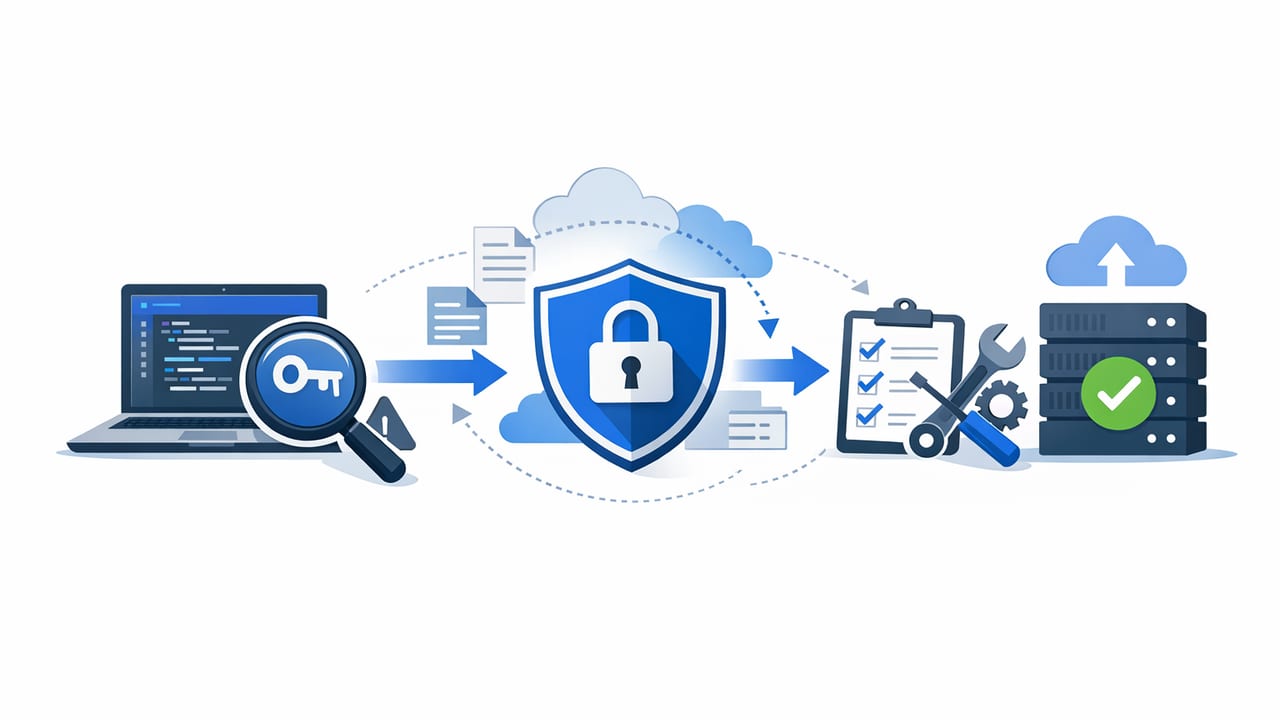
Secrets leaks are rarely caused by “bad security.” They’re usually caused by speed: a debug token pasted into a ticket, a cloud key committed during a hotfix, or an environment file uploaded to the wrong place. The difference between a minor mistake and a major incident is whether you have a secrets scanning and remediation workflow that detects exposures quickly and guides teams through rotation, revocation, and prevention.
This guide walks through a practical, automation-friendly workflow you can apply to source control, CI/CD, containers, and collaboration tools. It focuses on outcomes: reduce time-to-detect, reduce time-to-rotate, and reduce repeat exposures.
What “secrets scanning” should cover (and what it shouldn’t)
Secrets scanning is the practice of searching for sensitive values—API keys, passwords, tokens, private keys, connection strings—across places where they shouldn’t be. Most teams start with code repositories, but real-world exposure surfaces are wider:
- Git repositories: commits, pull requests, branches, tags, and history
- CI/CD logs: echoed environment variables, verbose debug output, build artifacts
- Container images: baked-in credentials in layers or config files
- Infrastructure-as-Code: Terraform, Helm charts, Kubernetes manifests
- Collaboration tools: wikis, tickets, chat exports, runbooks
What scanning shouldn’t do is become a noisy “regex machine” that floods teams with false positives. The scanning portion is only valuable when paired with a consistent remediation path—otherwise people learn to ignore alerts.
Principle: If you can’t remediate quickly, you don’t have an alert—you have background noise.
The core secrets scanning and remediation workflow (high-level)
A reliable workflow has the same shape regardless of tool choice:
- Detect: scan code, logs, and artifacts continuously
- Validate: confirm it’s a real secret and identify scope
- Contain: limit further exposure (disable, revoke, lock down)
- Rotate: replace the secret safely without downtime
- Eradicate: remove from code, history, artifacts, and docs
- Prevent: guardrails in dev, CI, and policy to stop repeats
- Verify: ensure no remaining references and monitor misuse
Where most organizations struggle is step 2 (validation) and step 4 (rotation). That’s where strong ownership, clear decision criteria, and automation matter most.
Workflow roles and handoffs (make ownership explicit)
Define who does what before the first incident. A simple RACI-style mapping reduces confusion during a leak.
| Stage | Input | Owner | Output |
|---|---|---|---|
| Detect | Scan finding (commit/PR/log/image) | Security tooling / DevOps | Alert + evidence (location, fingerprint) |
| Validate | Alert evidence | App owner + Security | Confirmed secret type, environment, blast radius |
| Contain | Confirmed secret | Security / Platform | Disabled key / tightened policy / blocked token |
| Rotate | Containment decision | App owner | New secret issued + deployed |
| Eradicate | New secret live | App owner + Repo admin | Leaked value removed (and from history if needed) |
| Prevent | Root cause notes | Platform + Security | Guardrails (pre-commit, CI policy, training) |
Step 1: Detection patterns that reduce false positives
Better detection is less about scanning “harder” and more about scanning “smarter.” Combine multiple signals:
- Detectors: known token formats (e.g., JWT-like patterns), provider-specific prefixes, PEM boundaries
- Entropy checks: high-entropy strings are suspicious, but should be weighted—many are harmless
- Context cues: variable names like
API_KEY,SECRET,password,token - Allowlisting: known test values, non-production fixtures, and documented dummy secrets
Run scans in three places:
- Developer workflow: pre-commit and pre-push checks
- CI gates: pull requests and merges to protected branches
- Continuous monitoring: default branch, tags/releases, and package registries
Example: CI gate for pull requests (GitHub Actions)
name: secrets-scan
on:
  pull_request:
    branches: [ "main" ]
jobs:
  scan:
    runs-on: ubuntu-latest
    steps:
      - uses: actions/checkout@v4
        with:
          fetch-depth: 0
      - name: Run secret scan
        run: |
          ./scripts/secret-scan.sh --path . --fail-on-high
      - name: Upload report
        if: always()
        uses: actions/upload-artifact@v4
        with:
          name: secrets-scan-report
          path: reports/secrets.json
Key ideas: scan PRs before merge, keep evidence artifacts, and make the build fail only on policy-defined severities (to avoid “CI always red”).
Step 2: Validation and triage (turn alerts into decisions)
Validation determines whether a finding is: (a) a real secret, (b) active, (c) production-impacting, and (d) exposed beyond the repo (e.g., logs, images, forks).
Use a short triage checklist:
- Secret type: API key, password, OAuth token, private key, session cookie, webhook signing secret
- Scope: what systems can it access? what permissions?
- Environment: production vs staging vs local
- Exposure surface: commit to public repo, internal repo, CI logs, image registry
- Time window: when first introduced; whether it was ever deployed
Where possible, validate programmatically (without “using” the secret). For example, many providers support introspection endpoints or key metadata checks. If that’s not available, treat unknowns conservatively: assume active until proven otherwise.
Step 3: Containment (stop the bleeding)
Containment aims to prevent further misuse while rotation is prepared. Depending on secret type, containment might include:
- Disable/revoke the credential immediately (preferred)
- Reduce permissions (temporary least-privilege) if immediate revocation would break production
- Block network paths or tighten firewall rules to reduce abuse potential
- Freeze deployments if the leak indicates broader compromise
Containment should be logged like an incident action: who changed what, when, and what follow-up is required.
Step 4: Rotation without downtime (the make-or-break step)
Rotation is replacing the exposed secret with a new one—without breaking dependent services. The safest approach is usually a two-secret overlap:
- Issue a new credential (new key/password/token)
- Deploy systems to accept/use the new secret (update apps, CI, runtime configs)
- Verify the new secret is in use (metrics, auth logs, synthetic checks)
- Revoke the old secret after a short overlap window
For databases and some APIs, you can use dual credentials temporarily (two users, two API keys, or versioned tokens). For secrets that cannot overlap (some signing keys), consider a coordinated cutover window and extra monitoring.
Rotation tip: decouple deploy from secret issuance
If your process requires a human to paste new values into multiple systems, rotation will be slow and error-prone. Treat rotation as an automated change: a pipeline updates the secret store, triggers config reloads, and verifies health checks before revoking the old secret.
Step 5: Eradication (remove the leaked value everywhere)
Eradication is more than deleting a line from the latest commit. Common eradication tasks:
- Remove from working tree: replace with environment reference or secret-store lookup
- Invalidate cached copies: rebuild images, purge artifacts, re-run CI with masked logs
- Remove from Git history if required: rewrite history, rotate again if the repo is public or widely cloned
- Scrub documentation: tickets, wikis, pastebins, chat messages
History rewriting is disruptive, so reserve it for high-severity exposures (public repo, high-privilege prod keys, or compliance requirements). If you can’t be sure all clones are cleaned, prioritize revocation and monitoring.
Step 6: Prevention guardrails (stop repeat exposures)
A mature secrets scanning and remediation workflow feeds prevention improvements back into engineering. The most effective guardrails are layered:
Developer-side guardrails
- Pre-commit scanning with clear, actionable messages
- Templates for config files (e.g.,
.env.example) that teach safe patterns - Local secrets injection via OS keychain, dev vault, or ephemeral tokens
CI/CD guardrails
- PR checks that block merges on high-confidence leaks
- Log masking for known secret variables (and avoid printing env)
- Policy-as-code rules for IaC that prevent plaintext secrets in manifests
Runtime guardrails
- Short-lived credentials (where possible) to reduce blast radius
- Least privilege and scoped tokens per service/environment
- Audit logging and anomaly detection for secret usage
Putting it together: an end-to-end workflow you can implement
Here’s a practical reference flow that many teams adopt:
- Scan every PR + scheduled scans of default branches and release tags
- Create a ticket automatically with evidence, severity, and owner mapping
- Auto-contain where safe (e.g., disable leaked CI token with limited scope)
- Guide rotation with runbooks (per secret type/provider) and overlap windows
- Verify with service checks + provider logs
- Revoke old credential + close out ticket with root cause
- Prevent repeat: update allowlists, add pre-commit rules, improve templates
Severity model: decide what blocks a merge vs what creates a task
A simple severity model helps avoid CI paralysis:
- Critical: production access, high privilege, public exposure → block merge + immediate containment
- High: non-prod but privileged, or production low privilege → block merge or require security review
- Medium: likely secret but unverified, internal repo → create ticket + remediation SLA
- Low: patterns match but context suggests test/dummy → warn only + allowlist review
Document these rules so teams know what to expect. The goal is consistent behavior, not perfect classification.
Metrics to track (so the workflow improves over time)
- MTTD (mean time to detect)
- MTTR (mean time to remediate/rotate)
- Repeat leak rate by repo/team/service
- False positive rate (alerts closed as non-secrets)
- Coverage: repos scanned, CI logs scanned, container registries scanned
Use these metrics to justify improvements like short-lived tokens, better masking, and stronger pre-commit adoption.
Common pitfalls (and how to avoid them)
- Scanning without ownership: assign repo/app owners automatically from CODEOWNERS or service catalogs.
- Rotating too late: containment should happen fast; rotation can follow with overlap to avoid outages.
- Over-relying on history rewrites: revocation and monitoring often matter more than perfect scrubbing.
- One-size-fits-all runbooks: database credentials, OAuth tokens, and signing keys have different rotation mechanics.
- Ignoring CI logs and artifacts: many real leaks happen outside source files.
Conclusion
A strong secrets scanning and remediation workflow is a security control and an operational capability. It turns inevitable human mistakes into manageable events by combining detection, fast containment, safe rotation, and prevention guardrails. Start small (PR scanning + a rotation runbook), then expand coverage to CI logs, images, and documentation, using metrics to drive improvements.
If you’re standardizing how teams store, rotate, and audit credentials across environments, a dedicated secrets management platform can simplify automation and compliance reporting—solutions like Vaulify are designed for that kind of centralized, policy-driven approach.