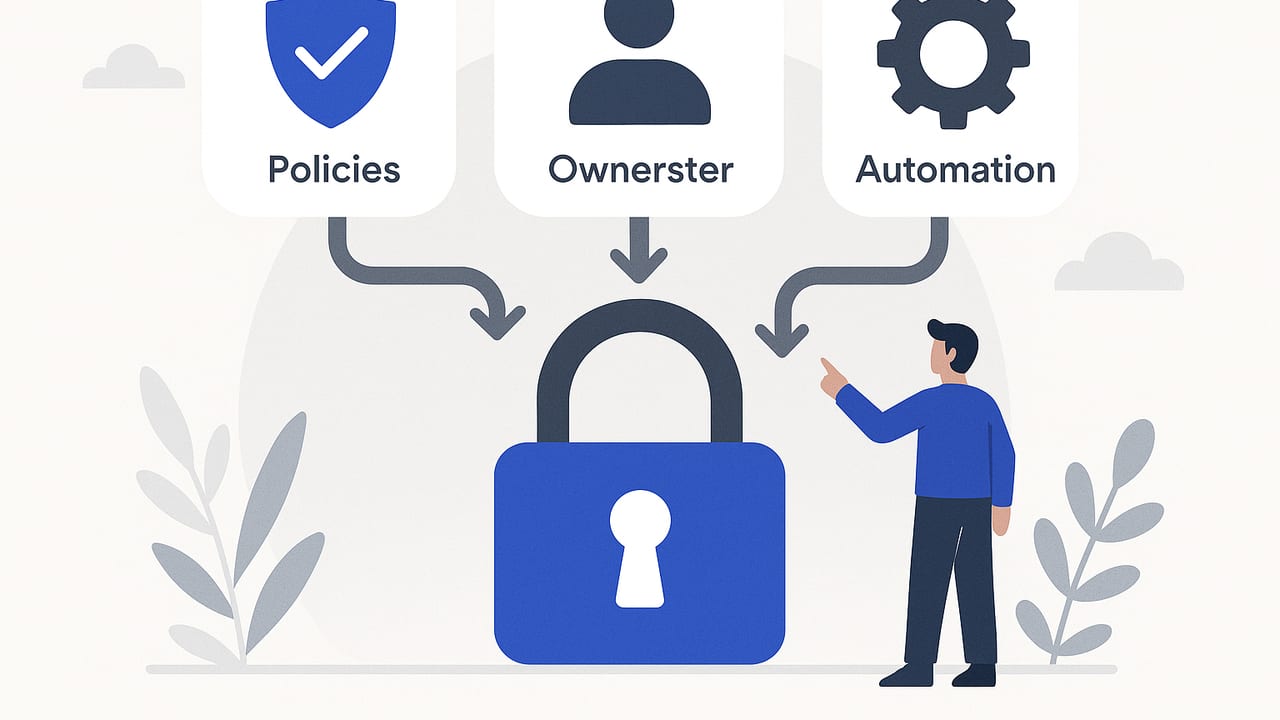
Secrets governance is no longer optional. As organizations scale microservices, integrate third-party APIs, and automate delivery pipelines, the number of credentials, keys, and tokens explodes. Without a clear governance model, teams inherit brittle defaults: long-lived secrets, unclear ownership, ad-hoc approvals, and audits that derail roadmaps. A well-designed secrets governance framework turns this chaos into predictable, measurable, and auditable control—without punishing developer velocity.
This guide explains how to build a practical governance model for secrets. You’ll learn the core principles, an operating model that assigns clear responsibilities, lifecycle controls, metrics that matter, and examples of policy-as-code and runbooks that you can adapt to your environment.
What Is Secrets Governance?
Secrets governance is the set of policies, roles, automated controls, and evidence that ensure secrets are created, used, rotated, and retired in a secure, compliant, and auditable way across the organization.
Governance is distinct from secrets management. Secrets management focuses on the tooling (vaults, KMS, brokers). Secrets governance defines who can create policies, how access and rotation are enforced, what evidence is preserved for audits, and how exceptions are handled. Together, governance and management deliver a trustworthy system that satisfies internal risk appetites and external requirements (e.g., SOC 2, ISO 27001, HIPAA, PCI DSS).
Core Principles of Secrets Governance
- Least privilege by default: Access scopes and TTLs are minimized, with ephemeral credentials preferred over static ones.
- Clear ownership: Every secret has a named owner (team and individual), business purpose, and lifecycle policy.
- Lifecycle control: Creation, rotation, revocation, and destruction are automated and recorded.
- Separation of duties: The person who defines policy cannot unilaterally grant privileged access.
- Policy-as-code: Policies are versioned, reviewed, tested, and enforced just like application code.
- Evidence by design: Logs, approvals, and attestations are captured automatically to satisfy audits.
- Developer ergonomics: Integrations with CI/CD, IDEs, and runtime platforms remove friction while honoring guardrails.
Operating Model: Roles and Responsibilities
Successful secrets governance hinges on clear ownership. Use a RACI-like approach so there’s no ambiguity.
| Role | Primary responsibilities in secrets governance |
|---|---|
| Security/GRC | Define enterprise policies, risk thresholds, classification, control objectives, and exception processes; oversee evidence for audits. |
| Platform/DevOps | Implement and operate vaults, brokers, and automation; codify policies and guardrails; integrate with CI/CD and cloud IAM. |
| Application Teams | Own secrets for their services; justify purpose/classification; rotate and retire per policy; respond to alerts and incidents. |
| Data Owners | Approve access to data-bound secrets and map secrets to data classification levels. |
| Internal Audit | Test control design and effectiveness; review evidence; validate exceptions are justified and time-bound. |
Lifecycle Controls for Secrets
1) Create and Classify
Every secret begins with a use case and a classification. Tie classification to risk: public (rare), internal, confidential, and restricted. Higher classes demand shorter TTLs, stricter approvals, and stronger authentication.
- Controls: Enforce mandatory metadata (owner, service, purpose, data classification). Block unclassified secrets.
- Guardrails: Disallow creation of long-lived static credentials for high-risk classes unless exception approved and time-boxed.
2) Store and Access
Centralize storage in an authorized vault and broker access via short-lived tokens. Prefer dynamic credentials over static ones, issued just-in-time and bound to workload identity (e.g., OIDC, SPIFFE/SPIRE).
- Controls: Enforce mTLS/OIDC-based auth, short TTLs, and granular scopes; record all access with correlation IDs.
- Guardrails: Deny plaintext secrets in code repos; run scanners in CI to block merges when secrets are detected.
3) Use and Rotate
Rotation must be automated and observable. For databases and cloud roles, use built-in rotation APIs or brokers that rotate without downtime, updating clients with new versions safely.
- Controls: Define rotation intervals per classification; require service-level runbooks; track last-rotated timestamps.
- Guardrails: Alert on secrets approaching expiry; quarantine workloads using expired or revoked credentials.
4) Retire and Destroy
When services are decommissioned, secrets should be revoked and destroyed; related access paths (roles, policies, firewall rules) cleaned up.
- Controls: Enforce destruction workflow; archive evidence; ensure revocation is verified by test connections failing as expected.
- Guardrails: Periodic job to find orphaned secrets without active owners or usage and initiate deprovisioning.
Policy-as-Code: A Practical Example
Policies should live in source control, reviewed via pull requests, tested, and enforced. Below is a sample YAML policy you can adapt to your vault or admission controller:
apiVersion: governance.v1
kind: SecretsPolicy
metadata:
  name: restricted-defaults
spec:
  classification:
    - name: restricted
      maxTTL: 1h
      rotation:
        interval: 24h
        jitter: 10m
      access:
        mfaRequired: true
        workloadIdentity: required
        network:
          allowedCIDRs:
            - 10.0.0.0/8
            - 192.168.0.0/16
  creation:
    requireFields: [owner, service, purpose, classification]
    denyPatterns:
      - password=.*  # no inline secrets in config
      - AKIA[A-Z0-9]{16}  # AWS key pattern
  approvals:
    restricted:
      minApprovers: 2
      approverRoles: [Security, DataOwner]
  exceptions:
    expiry: 30d
    evidence: required
  evidence:
    capture:
      - accessLogs
      - rotationEvents
      - approvals
      - exceptionTickets
Embed this in CI to validate pull requests modifying secret definitions, or in an admission webhook to enforce rules at runtime. For higher assurance, add tests (e.g., OPA/Rego, Conftest) that simulate requests against the policy.
Metrics and KPIs That Matter
Governance without measurement is wishful thinking. These metrics surface drift and quantify progress:
- Coverage: Percentage of workloads whose secrets are in the authorized vault and brokered via approved mechanisms.
- Secret Age Distribution: Median and 95th percentile age since last rotation, per classification.
- Rotation Success Rate: Percentage of automated rotations that complete without incident over a rolling window.
- Orphaned Secrets: Count and trend of secrets with no active owner or workload reference.
- Exception Debt: Number of open exceptions, average days open, and SLA adherence.
- Access Anomalies: Spikes in failed auth, denied policy checks, or access from unusual geolocations.
- Time to Revoke (TTR): Median time from incident flag to secret revocation and client remediation.
Define SLOs (e.g., 95% of restricted-class secrets rotated within 24 hours) and tie alerts to error budgets to drive continuous improvement.
Integrations and Automation Patterns
- CI/CD: Pre-merge scanning for hardcoded secrets; inject short-lived credentials at build/deploy time; prevent “secret sprawl” in pipeline logs.
- Cloud IAM: Federate workloads via OIDC to cloud providers; mint short-lived tokens; map policies to IAM roles automatically.
- Containers and Orchestrators: Sidecar or CSI drivers to deliver secrets at runtime; automatic reload on rotation; deny mounting file-based secrets for restricted workloads.
- Data Stores: Use dynamic DB users per workload; rotate passwords behind the scenes; enforce read-only roles where possible.
- Discovery: Scheduled scans across repos, images, buckets, and logs; push findings into triage with auto-redaction and ticketing.
- SIEM/SOAR: Forward secret access logs and policy decisions; automate incident steps like revoke, rotate, and notify.
Common Failure Modes (and How to Fix Them)
- Long-lived static credentials: Replace with short-lived tokens; if static required, enforce frequent rotation and per-source allowlists.
- Shadow secrets outside the vault: Use discovery scans and block egress of plaintext secrets; require registration in CMDB or service catalog.
- Manual approvals causing delays: Introduce context-aware auto-approvals for low-risk changes; reserve human approvals for restricted classes.
- Rotation breaks apps: Add dual-secret support and phased cutover; contract-based testing to verify client compatibility.
- Poor audit evidence: Automate capture of logs, approvals, and policy versions; store immutable evidence in an append-only system.
Secrets Governance Maturity Model
| Level | Policy | Access | Automation | Evidence |
|---|---|---|---|---|
| Ad hoc | Scattered guidelines | Shared static creds | Manual rotation | Logs incomplete |
| Defined | Central policy-as-code | Scoped roles, MFA | Scheduled rotations | Consistent audit trails |
| Optimized | Risk-based, tested | Ephemeral, workload identity | Event-driven, self-healing | Continuous attestation |
Audit Readiness: Evidence Checklist
- Policy repository with version history, reviews, and test results.
- Secrets inventory with owners, classifications, purpose, and last-rotated timestamps.
- Access logs correlating identity, workload, policy decision, and outcome.
- Exception register with justifications, expiry dates, and compensating controls.
- Rotation records and proof of revocation for decommissioned services.
- Segregation-of-duties mapping and approval trails.
Incident Runbook: Suspected Secret Leak
- Detect: Triage alert from scanner/SIEM; identify secret scope and classification.
- Contain: Immediately revoke or rotate the credential; quarantine affected workloads.
- Eradicate: Remove leaked copies from repos, artifacts, and logs; invalidate caches.
- Recover: Redeploy with new secrets; verify connectivity and access policies.
- Notify: Inform owners, security, and stakeholders per severity; document actions.
- Learn: Root cause analysis; update policy, tests, and scanners; close gaps.
Quick Start: 30/60/90-Day Plan
- Days 0–30: Establish core policy-as-code; inventory high-risk secrets; enable CI scanning; require owner and classification metadata.
- Days 31–60: Integrate workload identity; automate rotation for top data stores; implement dual-secret support; stand up exception workflow.
- Days 61–90: Expand dynamic credentials; define SLOs and dashboards; wire SIEM/SOAR automation; run a tabletop incident exercise.
Practical Tips for Lasting Success
- Make the secure path the easiest path—ship templates, SDKs, and reusable modules.
- Start with restricted-class secrets and work down; celebrate measurable wins.
- Codify everything: policies, workflows, tests, and evidence collection.
- Design for change: new services, new regions, new vendors—no policy rewrites required.
Effective secrets governance is both a security imperative and a productivity unlock. By combining clear roles, lifecycle controls, automation, and evidence, you’ll reduce risk while letting teams move faster and safer. If you’re evaluating platforms to support these practices, Vaulify offers a focused approach to secure secrets management with automation and compliance capabilities that align well with governance-by-design.