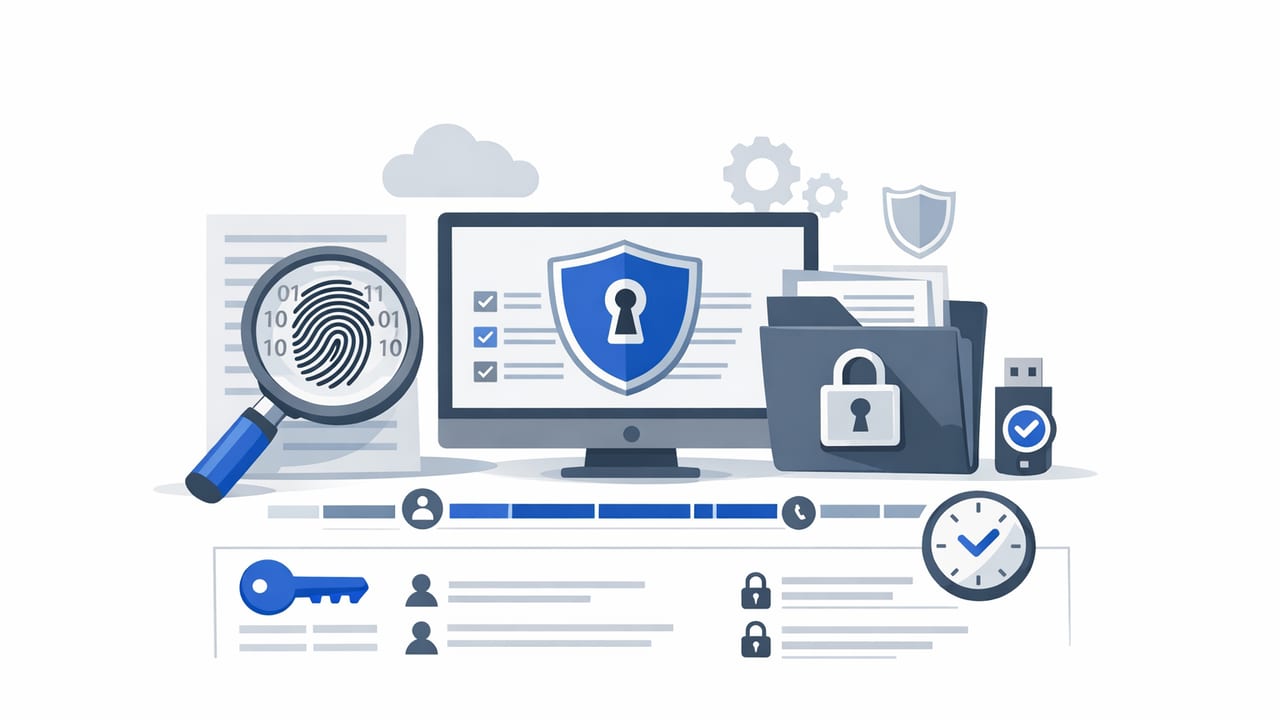
Secrets management is only as trustworthy as your ability to answer a simple question: Who accessed which secret, when, from where, and why? That answer comes from secrets audit logging—the practice of recording and protecting high-fidelity events across the entire secrets lifecycle (creation, access, rotation, deletion, policy changes, and failures).
Done well, secrets audit logging supports incident response, insider-risk detection, and compliance evidence without leaking secret values. Done poorly, it becomes either an unusable firehose or, worse, a new source of sensitive data exposure.
“If you can’t audit it, you can’t prove it—or improve it.”
Why secrets audit logging matters
Modern environments (microservices, CI/CD, multi-cloud, SaaS integrations) create countless opportunities for secrets to be misused. Secrets audit logging helps you:
- Investigate incidents fast: Trace which workload or user accessed a credential before suspicious activity started.
- Detect misuse early: Identify abnormal access patterns (e.g., API key read bursts, access from new regions, repeated failures).
- Prove compliance: Provide evidence that access is controlled, reviewed, and attributable (common across SOC 2, ISO 27001, PCI DSS, HIPAA-aligned programs, and internal governance).
- Reduce blast radius: Pinpoint the smallest set of secrets and identities impacted by a compromise.
- Improve operations: Discover brittle dependencies (apps relying on deprecated secrets, rotations causing retries, unauthorized “break-glass” usage).
What to log: the minimum viable event set
The goal of secrets audit logging is complete accountability without recording secret material. You generally want coverage across four categories: access, lifecycle, governance, and system behavior.
1) Access events (reads and uses)
- Secret read: A user, service account, or workload retrieved a secret (or a version).
- Secret use via broker: If your platform supports dynamic credentials or short-lived tokens, log issuance and revocation.
- Denied access: Authorization failures are often more valuable than successful reads.
- Bulk/list operations: Listing secret names/paths can be reconnaissance; log it.
2) Lifecycle events (change and rotation)
- Create, update, new version, disable, delete, restore
- Rotate started/completed/failed
- Policy-driven expiry and manual overrides
3) Governance events (who changed the rules)
- Policy changes (RBAC/ABAC, path permissions, approvals)
- Auth changes (new identity provider mappings, MFA enforcement, SSO config)
- Role and group membership changes
- Break-glass enablement and emergency access grants
4) System and integrity events
- Configuration changes (logging destinations, retention, encryption settings)
- Replication/sync events (multi-region vaults)
- Key management events (KMS key rotation, seal/unseal, HSM state changes)
- Health anomalies (clock drift, storage errors, audit pipeline failures)
Log fields you should capture (without leaking secrets)
Secrets audit logging is most useful when events are consistently structured. The following fields provide strong investigative value while avoiding secret disclosure:
| Field | Why it matters | Notes |
|---|---|---|
| timestamp (UTC) | Ordering and correlation across systems | Ensure time sync (NTP) and record ingestion time too |
| actor.identity | Attribution (user/service/workload) | Include principal ID, type, and auth method (SSO, workload identity) |
| action | Standardized verbs enable reliable alerts | Examples: secret.read, secret.rotate, policy.update |
| resource | Which secret/path was targeted | Log secret ID/path and version metadata, not the value |
| decision | Was it allowed or denied? | Include reason codes (policy deny, missing MFA, expired token) |
| request.context | Helps spot anomalies | Source IP, region, user-agent, workload name, cluster, namespace |
| correlation IDs | Trace a chain of events | Request ID, session ID, CI job ID, deploy ID |
| change summary | Proves what changed (without sensitive data) | For policy/config, log a diff hash and high-level fields changed |
A critical rule: never record secret values, raw tokens, private keys, or full credential strings. If you need to prove two versions differ, log non-reversible fingerprints (e.g., a salted hash) and rotation metadata.
Design principles for trustworthy secrets audit logging
Make logs tamper-evident
Attackers who can access secrets may try to erase the trail. Apply controls that make audit data hard to alter unnoticed:
- Write-once destinations (WORM storage, immutable buckets, or append-only logging backends).
- Separate duties: admins who manage secrets should not control log retention and deletion.
- Integrity checks: chain hashes across batches, sign log blocks, or use a managed service that provides immutability guarantees.
Ensure completeness and continuity
- Log before respond for sensitive actions: record the event even if downstream delivery fails.
- Buffer safely: use durable queues to prevent loss during spikes.
- Alert on audit pipeline failures: missing logs are a security incident.
Balance observability with privacy
Secrets audit logging can inadvertently capture personal data (usernames, IPs) or confidential infrastructure metadata. Treat logs as sensitive:
- Encrypt logs in transit and at rest.
- Restrict access with least privilege and strong authentication.
- Apply data minimization: store what you need to investigate and comply.
Example: a structured audit event (safe by design)
Here’s a simplified example of a secret.read audit entry that captures accountability without exposing secret material:
{
  "timestamp": "2026-02-09T14:22:31.482Z",
  "action": "secret.read",
  "decision": "allow",
  "actor": {
    "type": "workload",
    "id": "spiffe://prod/ns/payments/sa/api",
    "auth_method": "workload_identity"
  },
  "resource": {
    "kind": "secret",
    "path": "prod/payments/stripe_api_key",
    "version": "v12"
  },
  "request": {
    "source_ip": "10.2.18.44",
    "region": "us-east",
    "user_agent": "vault-client/3.4.1",
    "correlation_id": "req_8f4c2c0d"
  },
  "risk": {
    "sensitivity": "high",
    "rate_limited": false
  }
}
Retention, storage, and compliance mapping
Retention requirements vary by industry and risk profile. The key is to define a policy that meets regulatory expectations and supports investigations.
- Hot retention (searchable in SIEM): commonly 30–180 days for fast investigations and alerting.
- Warm/cold retention (archived, immutable): commonly 1–7 years depending on contracts and regulations.
- Legal hold: ability to preserve logs for specific cases without modifying the default policy.
When auditors ask for evidence, secrets audit logging typically supports controls like:
- Access is authorized and reviewed (who accessed what, and whether it was permitted).
- Changes are approved and traceable (policy updates, role changes, break-glass).
- Security events are monitored and responded to (alerts, incident tickets linked to audit events).
Alerting: turning secrets audit logs into detections
Logs are only valuable if they drive action. Start with clear, low-noise detections:
High-signal alert rules
- Access from a new environment: a prod secret read from a non-prod cluster/namespace.
- Impossible travel / new geolocation: human user access from a region never seen before.
- Spike in secret reads: sudden burst from a single actor or IP.
- Repeated denies: brute force, misconfigured service, or malicious probing.
- Break-glass usage: any emergency access should page immediately and require post-incident review.
- Policy changes followed by access: policy.update then secret.read within minutes by the same actor.
Example: simple query logic (SQL-like)
-- Detect unusual read volume for a single actor in 10 minutes
SELECT actor_id, COUNT(*) AS reads
FROM audit_logs
WHERE action = 'secret.read'
  AND decision = 'allow'
  AND timestamp > NOW() - INTERVAL '10 minutes'
GROUP BY actor_id
HAVING COUNT(*) > 200;
Use these as starting points, then tune thresholds per environment (prod vs dev), secret sensitivity, and expected application behavior.
Common mistakes (and how to avoid them)
Mistake 1: Logging secret values
This is the fastest way to turn audit logs into a breach multiplier. Fix it by implementing strict redaction and adding automated tests that fail builds if sensitive fields appear in logs.
Mistake 2: Inconsistent event names and schemas
If each system logs differently, correlation becomes slow and error-prone. Standardize action names and required fields, version your schema, and validate at ingestion.
Mistake 3: Treating denied events as “noise”
Denied events often reveal reconnaissance, policy gaps, or misconfigurations that will later become incidents. Keep them, but route them through sensible alerting and aggregation.
Mistake 4: No alert when logging breaks
If the audit pipeline stops, you lose visibility exactly when you may need it most. Monitor for ingestion drops, queue growth, and storage permission changes.
Mistake 5: Too much access to audit logs
Audit logs contain sensitive operational metadata. Use least privilege, separate roles, and track access to the logs themselves.
A practical checklist for implementing secrets audit logging
- Define event coverage: access, lifecycle, governance, system integrity.
- Standardize schema: timestamp, actor, action, resource, decision, context, correlation IDs.
- Redact aggressively: never store secret values; test for leaks.
- Centralize ingestion: ship to SIEM/log analytics with reliable buffering.
- Make logs immutable: append-only storage and separation of duties.
- Set retention tiers: hot for alerting, cold for compliance and investigations.
- Build detections: start with high-signal alerts and tune.
- Run drills: simulate a secret compromise and measure time-to-trace.
- Review regularly: quarterly schema and alert reviews as systems evolve.
Closing thoughts
Strong secrets audit logging is a security control, an operational safety net, and a compliance enabler. It works best when it’s structured, tamper-evident, privacy-aware, and tied directly to actionable detections. If you’re evaluating or improving a secrets platform, prioritize audit event quality and integrity features as highly as encryption and access control.
Some teams look for a secrets manager that treats audit logging as a first-class capability; if that’s your direction, platforms like Vaulify are often evaluated alongside broader vaulting solutions.