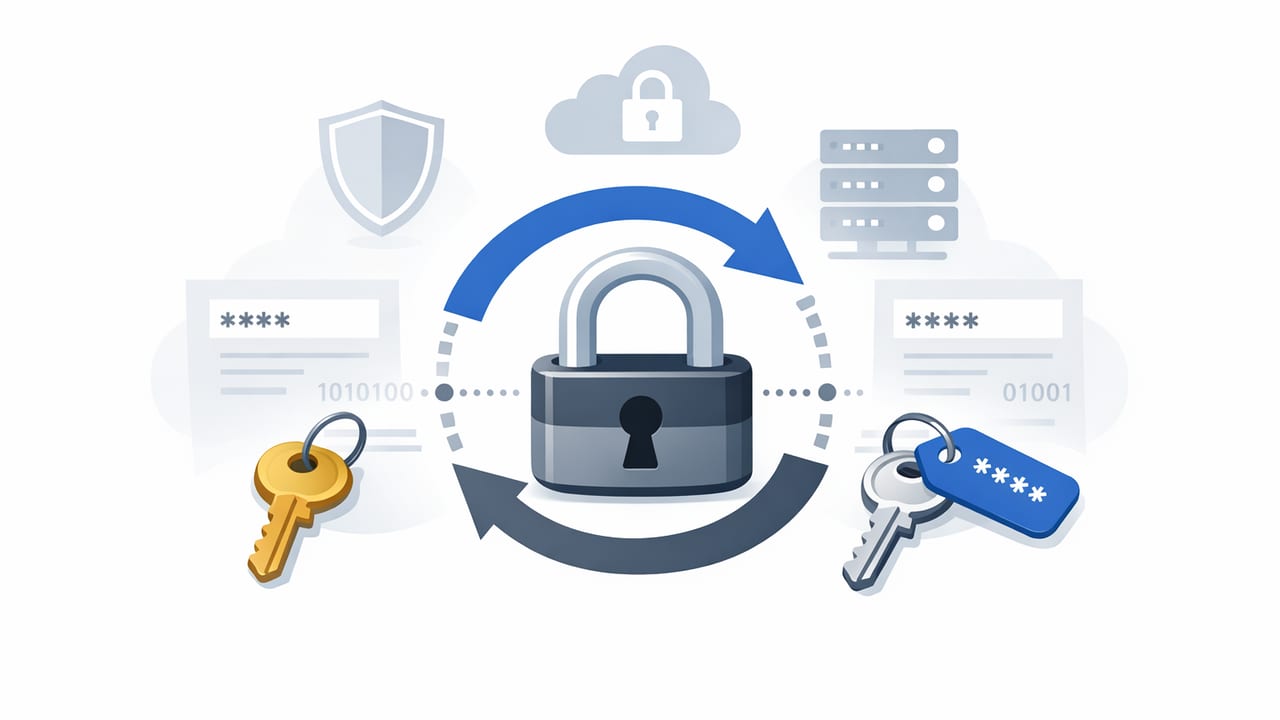
Secret rotation is the disciplined process of changing sensitive credentials—API keys, database passwords, signing keys, certificates, and tokens—on a repeatable schedule or in response to events. In modern secrets management, rotation is not just “good hygiene”; it’s a core control for cybersecurity, API security, and compliance. Yet many teams delay it because rotation can break deployments, cause outages, or create operational noise.
This guide explains how to implement secret rotation with automation, validation, and safe cutovers—so you reduce blast radius without sacrificing reliability.
Why secret rotation matters (beyond compliance)
Rotating secrets reduces the time window an attacker can exploit a leaked credential. Leaks happen through code repos, CI logs, chat tools, misconfigured storage, vendor incidents, and endpoint malware. Rotation also helps you:
- Limit blast radius: short-lived credentials reduce the impact of exfiltration.
- Improve incident response: a proven rotation pipeline lets you invalidate compromised secrets quickly.
- Enforce least privilege: rotation projects often reveal overly broad permissions and stale accounts.
- Produce better audit evidence: automated workflows generate repeatable logs for governance.
“If you can’t rotate a secret safely on a normal day, you won’t be able to rotate it fast during an incident.”
Define what “rotation” means in your environment
Teams often treat all secrets the same, but rotation should match secret type and dependency patterns. Start by classifying secrets into categories with distinct rotation methods and risks.
| Secret type | Common examples | Rotation pattern | Downtime risk |
|---|---|---|---|
| Static shared secrets | API keys, webhook secrets | Dual-key / overlap window | Medium |
| Credential pairs | DB username/password | Create new user, cut over, revoke old | Medium–High |
| Short-lived tokens | OIDC, OAuth access tokens | Auto-expiry (no “rotation”), rotate signing keys | Low |
| Certificates / keys | TLS certs, JWT signing keys | Versioned keysets, staged rollout | High if unmanaged |
| Machine access | SSH keys | Ephemeral certs or periodic key replacement | Medium |
A practical rotation policy (schedule + triggers)
A rotation policy should be simple enough to follow and strict enough to reduce risk. Combine time-based rotation with event-based triggers:
Time-based schedules
- High-risk external secrets: 30–90 days (public-facing API keys, third-party integrations).
- Internal service credentials: 60–180 days (service-to-service, internal APIs).
- Signing keys / certificates: align with crypto best practices (e.g., shorter lifetimes, planned key rollovers).
- Human passwords: prefer MFA + strong auth over frequent forced password changes, except where policy requires it.
Event-based triggers
- Suspected compromise (alert, unusual usage, leaked repo).
- Employee offboarding or vendor access change.
- Permission changes (scope expansion warrants fresh keys).
- Infrastructure migration (moving environments, new clusters).
Tip: Make the policy measurable: specify maximum secret age, ownership, and expected rotation success rate (e.g., “99% of production secrets rotate automatically without manual steps”).
The core challenge: avoiding downtime during cutover
Rotation fails most often at the cutover stage—when producers and consumers of the secret don’t switch at the same time. Use patterns that allow overlap and verification.
1) Dual-secret (overlap) pattern for API keys
Many external systems support multiple valid keys. Keep old and new keys valid during a grace period:
- Generate a new key.
- Deploy consumers to prefer the new key but fall back to the old key.
- Verify new-key usage in logs/metrics.
- Revoke the old key after the overlap window.
2) Create-new-then-revoke for database credentials
Instead of changing a shared password in place, create a new database user (or new password for a dedicated user), cut services over, and then remove the old credential. This allows rollback if the new credential breaks connectivity or permissions.
3) Versioned keysets for signing keys
For JWT or similar signing, publish a keyset (e.g., via JWKS) with multiple keys. Sign with the newest key ID while verifiers accept prior key IDs until expiry. This makes rotation predictable and minimizes outages.
Automate secret rotation end-to-end
Automation is what turns rotation from an occasional fire drill into a reliable control. A complete secret rotation workflow typically includes:
- Generation: create the new secret with strong entropy and correct format.
- Distribution: store it securely and deliver it to the right workloads.
- Activation: update consumers (apps, jobs, gateways) to use the new secret.
- Validation: confirm new secret works (health checks, synthetic transactions).
- Revocation: disable old secret after a safe overlap window.
- Audit logging: record who/what rotated, what changed, and when.
Reference workflow (rotation runbook)
The following runbook structure scales well across teams and secret types:
- Pre-checks: identify all consumers; confirm you can deploy changes; confirm rollback plan.
- Rotate: create new secret and store as version N+1.
- Rollout: deploy consumers to read version N+1 (or “latest”).
- Verify: run automated tests + monitor error rates and auth failures.
- Revoke: remove version N after the grace period.
- Post-checks: confirm no traffic uses old secret; document evidence for compliance.
Implementation example: app-side fetching with TTL and safe refresh
One reason rotation breaks apps is “read secret once at startup.” A more resilient pattern is to fetch secrets at runtime with caching and a refresh interval. Here’s a simplified example in Python-like pseudocode:
import time

CACHE = {"value": None, "expires_at": 0}

def fetch_from_secret_store(secret_name):
    # Replace with your secret manager API call.
    # Must use authenticated, least-privileged access.
    return secret_store.get(secret_name)

def get_secret(secret_name, ttl_seconds=300):
    now = time.time()
    if CACHE["value"] is None or now > CACHE["expires_at"]:
        new_value = fetch_from_secret_store(secret_name)
        CACHE["value"] = new_value
        CACHE["expires_at"] = now + ttl_seconds
    return CACHE["value"]

def call_partner_api():
    api_key = get_secret("partner_api_key")
    return http.get("https://partner.example/api", headers={"Authorization": f"Bearer {api_key}"})
Why it helps: if you rotate the secret in the store, the app picks it up within minutes—without a restart—reducing downtime risk. You still need safeguards (rate limiting, retries, and alerting) so a secret-store outage doesn’t become an application outage.
Monitoring and verification: prove the new secret is actually in use
Secret rotation isn’t done when the new value exists; it’s done when the old value is no longer used. Verification should include:
- Auth failure rates: 401/403 spikes, DB auth errors, TLS handshake failures.
- Consumer inventory: confirm every service, job, and pipeline has rolled forward.
- Usage telemetry: where possible, measure which key ID (or credential) is used.
- Canary checks: synthetic transactions using the new secret before broad rollout.
If the target system supports key identifiers (kid), token introspection, or per-key analytics, incorporate them into a simple “old vs new” dashboard for the overlap period.
Common pitfalls (and how to avoid them)
Hard-coded secrets and config drift
Rotation fails when secrets are embedded in source code, container images, or static config files. Treat this as a prerequisite:
- Remove secrets from repos and build artifacts.
- Use runtime injection (sidecar, agent, init container, or SDK fetch).
- Standardize secret references (names/paths) so “latest” can be updated centrally.
Shared credentials across many consumers
A single API key used by multiple apps makes rotation risky. Prefer unique credentials per service so you can rotate incrementally and revoke precisely.
Rotation without permission review
Don’t rotate a secret and keep excessive privileges. Rotation is an opportunity to shrink scopes, segment environments (dev/stage/prod), and remove unused access.
No break-glass plan
Automation should have an emergency path: temporary credentials, time-limited admin actions, and clear on-call ownership. Break-glass access should be logged, reviewed, and minimized.
Checklist: a rotation-ready secrets program
- Inventory: you know what secrets exist, where they live, and who owns them.
- Classification: secrets grouped by type, risk, and rotation pattern.
- Automation: rotation pipelines for top-risk secrets (external APIs, prod DBs).
- Safe cutover: dual-secret overlap or versioned keysets where applicable.
- Runtime consumption: apps can refresh secrets without full redeploys when feasible.
- Verification: metrics and logs confirm new usage and old deprecation.
- Revocation: old secrets disabled on a defined timeline.
- Audit evidence: immutable logs of rotations, approvals, and access events.
How to start: a 30-day rollout plan
If you’re building secret rotation from scratch, start small and iterate:
- Week 1: inventory your highest-risk secrets (public-facing and third-party integrations). Assign owners.
- Week 2: implement dual-secret support for one integration; add monitoring for auth failures and key usage.
- Week 3: automate rotation for that integration (generation → store update → rollout → revoke).
- Week 4: repeat for one database credential using create-new-then-revoke; document a standard runbook.
After that, prioritize secrets by exposure and impact. The goal is not “rotate everything weekly,” but to make rotation routine, verifiable, and low-risk.
Final thoughts
Effective secret rotation is a blend of policy, engineering, and operations: clear schedules and triggers, overlap-aware cutovers, automation with validation, and evidence-ready logging. When done well, rotation becomes a quiet background control that measurably improves data protection and reduces incident impact.
If you’re evaluating tooling to support automation and auditing in a secrets management program, platforms like Vaulify can help centralize rotation workflows and access controls without turning rotation into a manual burden.