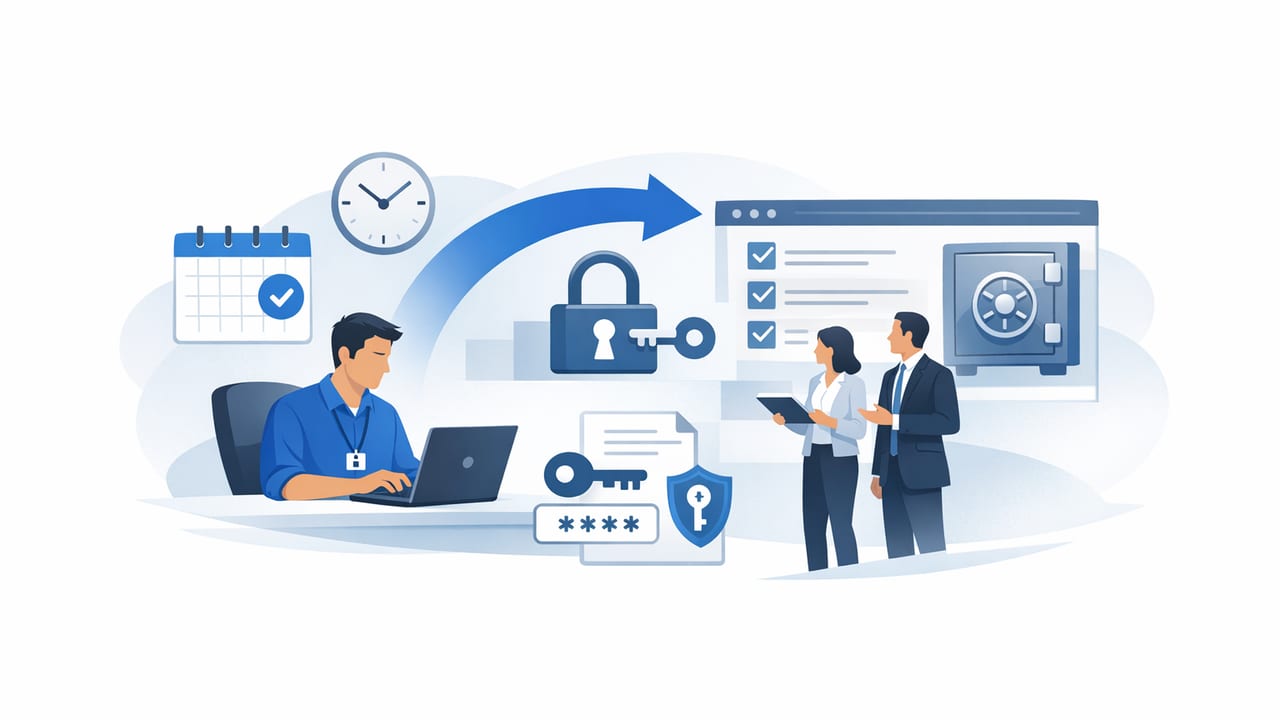
When a team decides to centralize credentials, the biggest blocker is rarely the technology—it’s the onboarding. Developers need working access without friction, security needs governance, and operations needs a path to automation. This guide is designed to help you achieve same day onboarding for secrets management teams without sacrificing security fundamentals.
You’ll learn a realistic day-one plan, a minimum viable governance model, and concrete implementation patterns for applications and CI/CD. The goal is not perfection; it’s a safe, auditable baseline you can improve iteratively.
What “same-day onboarding” should (and shouldn’t) mean
Same-day onboarding is successful when:
- Users authenticate via SSO (or another centralized identity) with role-based access.
- At least one production-like app pulls secrets at runtime (not from source control).
- CI/CD retrieves short-lived credentials or scoped tokens for deployments.
- Audit logs exist for secret access and policy changes.
Same-day onboarding does not mean:
- Every legacy secret is migrated.
- Every team has custom policies.
- Rotation is fully automated for all systems.
“Speed is a security feature when it eliminates shadow secrets—spreadsheets, wikis, and hardcoded keys. The trick is to move fast with guardrails.”
Prerequisites you can confirm in 30 minutes
Before you start onboarding, confirm these items. If any are missing, decide a temporary workaround for day one.
- Identity provider: Okta, Azure AD, Google Workspace, etc. (for SSO groups).
- Target platform: at least one environment (Kubernetes, VMs, serverless, or a PaaS).
- CI/CD system: GitHub Actions, GitLab CI, CircleCI, Jenkins, etc.
- Two example secrets: one API key and one database credential (or a mock).
- Owner assignments: a security owner and a platform/app owner for approvals.
A same-day onboarding schedule (you can actually follow)
Below is a practical timeline for getting a team to “first value” within a day. Adjust timeboxes, but keep the sequence.
| Timebox | Goal | Deliverable |
|---|---|---|
| 0–60 min | Define scope and naming | Secret paths, environments, and owners documented |
| 60–120 min | SSO + baseline roles | Admin, App Deployer, Read-Only Auditor roles mapped to groups |
| 120–240 min | First secret stored + retrieved | App reads a secret from the manager in dev |
| 240–360 min | CI/CD integration | Pipeline step fetches scoped secret/token without hardcoding |
| 360–480 min | Audit + guardrails | Logging enabled, policy review checklist, break-glass access defined |
Step 1: Set a simple secret taxonomy (avoid day-one chaos)
A clean structure prevents a thousand one-off exceptions later. On day one, standardize three dimensions:
- Environment:
dev,staging,prod - Service/application:
billing-api,web-frontend - Secret type:
db,third-party,jwt
Example path pattern:
env/{environment}/{service}/{type}/{name}

env/prod/billing-api/db/main
env/staging/web-frontend/third-party/stripe_api_key
Tip: keep names boring and searchable. Avoid personal names (alice_key) and vague labels (new_key).
Step 2: Baseline access model (RBAC on day one, fine-grained later)
Same-day onboarding succeeds when access requests are predictable. Start with three roles:
- Secrets Admin: manages engines/integrations, can create policies, limited to platform/security.
- App Deployer: can read deployment-time secrets for a given service/environment.
- Auditor: read-only access to logs/metadata, no secret values.
Map these roles to identity groups (SSO). If you can’t integrate SSO immediately, implement temporary accounts with enforced MFA and a firm sunset date.
Break-glass access (define it now, not during an incident)
Break-glass access is an emergency path for outages and incidents. Keep it narrow:
- Time-bound elevation (e.g., 1 hour)
- Approval workflow (ticket + on-call security)
- Mandatory logging and post-incident review
Step 3: Put one real secret into the system and use it in an app
The fastest way to build trust is to make a real application work end-to-end. Choose a low-risk integration first (e.g., a non-critical third-party API key in dev), then repeat the pattern for production.
Runtime retrieval pattern: inject via sidecar/agent or init step
Many teams start with a pattern that avoids embedding secrets in container images or repos. Conceptually:
- Workload authenticates (Kubernetes service account, cloud identity, etc.).
- Secrets manager returns the secret (ideally short-lived where possible).
- Secret is delivered to the app as an environment variable or file in memory.
Example: application reads a secret from an injected file:
// Node.js example (runtime secret from mounted file)
import fs from "fs";

const apiKey = fs.readFileSync("/run/secrets/stripe_api_key", "utf8").trim();

// Use apiKey with your API client
console.log("Stripe key loaded:", apiKey.slice(0, 6) + "...");
Why this helps on day one: developers get a familiar interface (env/file), while security gets centralized storage, access control, and auditing.
Step 4: CI/CD onboarding without leaking secrets
CI/CD is often where secrets sprawl the fastest: repository variables, shared runners, copied tokens. For same-day onboarding, focus on one pipeline and implement two safeguards:
- Scoped access: the pipeline can read only what it needs for that service/environment.
- Short-lived credentials: prefer OIDC/workload identity to static tokens.
Minimal CI example (generic)
This example illustrates the flow: exchange an identity token for a short-lived secret access token, then fetch a secret during the job.
# Pseudocode (conceptual steps)
# 1) Job receives OIDC identity from CI provider
# 2) Exchange OIDC for secrets-access token (short-lived)
# 3) Read secret and export for later steps

ACCESS_TOKEN=$(secretsctl auth oidc --audience "$CI_AUDIENCE")
DB_PASSWORD=$(secretsctl read env/staging/billing-api/db/main --field password --token "$ACCESS_TOKEN")

export DB_PASSWORD
./deploy.sh
Important: ensure job logs never print secrets. Mask values, disable debug output, and restrict who can re-run jobs.
Step 5: Logging, auditability, and “day-one compliance”
You don’t need a full compliance program to be audit-ready. You need consistent records and clear ownership.
Day-one audit checklist
- Access logs enabled: who read what, when, from where.
- Change logs enabled: policy edits, secret writes/updates, role assignments.
- Retention set: align with internal policy (often 90–365 days).
- Ownership recorded: each secret path has an owner group (not an individual).
If your organization has SOC 2 / ISO 27001 expectations, treat this as the minimum evidence trail you can expand later (rotation metrics, periodic access reviews, and separation of duties).
Common pitfalls that derail same-day onboarding
- Over-modeling policies too early: start with simple RBAC; refine with least privilege once usage is proven.
- Migrating everything at once: pick one service and one pipeline; make it repeatable.
- Ignoring developer ergonomics: if retrieval is clunky, people will create shadow secrets.
- Static credentials everywhere: prioritize short-lived tokens for CI/CD and dynamic DB creds where feasible.
- No break-glass path: teams will invent one under pressure—usually insecurely.
How to scale after day one (without rework)
Once the first team is onboarded, scale by templatizing:
- Blueprints: a standard policy per service, per environment.
- Automation: infrastructure-as-code to provision secret paths, roles, and integrations.
- Rotation: start with the highest-risk secrets (cloud keys, shared service accounts).
- Access reviews: quarterly reviews for production paths, triggered reviews after incidents.
Suggested “definition of done” for each onboarded service
- Secrets removed from repos and build configs
- Runtime retrieval implemented
- CI/CD uses scoped and preferably short-lived access
- Logs and ownership confirmed
- Rotation plan documented (even if not automated yet)
Quick reference: same-day onboarding runbook
If you need a copy/paste-friendly runbook for your internal wiki, use this:
- Pick one service + one environment + two secrets.
- Define secret path naming and owners.
- Connect SSO and create three roles: Admin, App Deployer, Auditor.
- Store secrets; validate read access with least-privileged role.
- Integrate one application runtime retrieval pattern (file/env injection).
- Integrate one CI job using scoped access and masked logs.
- Enable audit logs and set retention.
- Document break-glass procedure and review cadence.
Final thoughts
Same-day onboarding works best when you treat secrets management like an internal product: prioritize the first user experience, make the secure path the easiest path, and keep governance lightweight but real. Once developers see that secure secrets are faster—not slower—adoption becomes self-sustaining.
If you’re evaluating platforms to support this approach, solutions like Vaulify are designed to streamline secure storage, access control, automation, and auditability—key ingredients for getting teams onboarded quickly without lowering security standards.