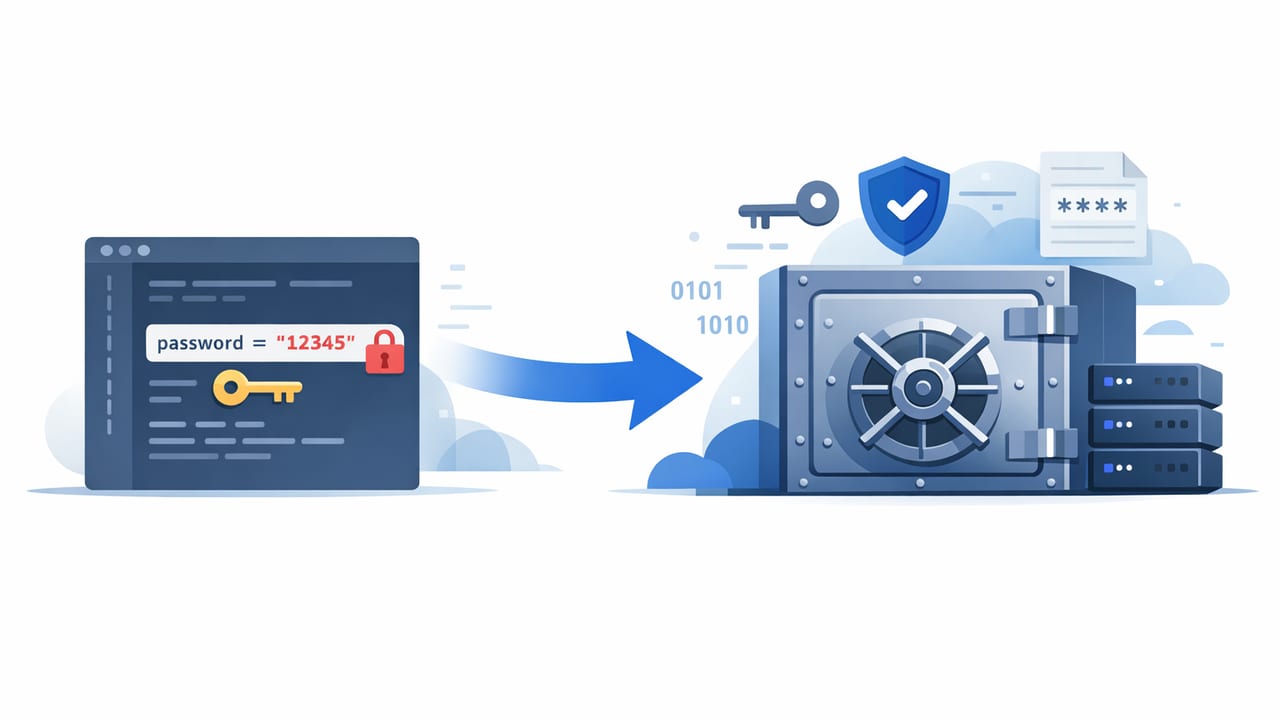
Hardcoded secrets are one of the most common—and most preventable—causes of security incidents. API keys committed to Git, database passwords baked into container images, and shared “temporary” credentials in chat all create the same problem: sensitive access is copied into places you can’t reliably control, rotate, or audit.
This guide explains how to migrate from hardcoded secrets to vault-based secrets management without breaking production. You’ll get a practical plan for discovery, refactoring, CI/CD integration, access controls, rotation, and verification—plus common pitfalls to avoid.
What counts as a hardcoded secret?
A secret is any value that grants access or enables impersonation. “Hardcoded” means it’s embedded where it doesn’t belong—source code, configuration files, images, or templates—rather than retrieved at runtime from a controlled system.
- Static credentials: database passwords, service accounts, SMTP credentials
- API tokens/keys: cloud APIs, third-party SaaS, internal services
- Private keys: SSH keys, JWT signing keys, TLS keys
- High-risk config: webhook signing secrets, encryption keys, OAuth client secrets
Rule of thumb: If leaking it would require incident response, it should not be hardcoded.
Why migrate from hardcoded secrets to a vault?
A vault (secrets manager) centralizes storage and access to secrets with strong controls. Compared to hardcoding, it enables:
- Rotation without redeploys (or with minimal redeploy)
- Least-privilege access per workload, environment, and identity
- Audit logging for who/what accessed which secret and when
- Short-lived credentials (dynamic secrets) to reduce blast radius
- Automation in CI/CD and runtime injection
Migration checklist (high-level)
- Discover where secrets live today (code, repos, pipelines, images).
- Classify secrets by criticality and rotation feasibility.
- Design naming, access policies, and environment separation.
- Refactor apps to load secrets at runtime (not build time).
- Integrate CI/CD and deployment tooling with the vault.
- Rotate credentials and decommission old copies.
- Verify with tests, monitoring, and audit trails.
Step 1: Discover hardcoded secrets (and stop new ones)
Before you move anything, get a clear inventory. Typical locations include:
| Where secrets hide | Examples | How to detect | Migration note |
|---|---|---|---|
| Source code | Strings in config files, constants | Secret scanning in Git + code review | Refactor to runtime fetch |
| Repo history | Deleted keys still in commits | Scan full history | Rotate immediately; consider history rewrite |
| CI/CD variables | Pipeline env vars, masked variables | Pipeline inventory + access review | Use short-lived tokens to fetch from vault |
| Container images | .env copied during build | Image scanning + Dockerfile review | Move to runtime injection |
| Kubernetes manifests | ConfigMaps/Secrets committed to Git | Repo scan + cluster audit | Use external secrets or sidecar injection |
At the same time, prevent regression:
- Enable pre-commit hooks and CI secret scanning.
- Block merges that introduce high-confidence secrets.
- Teach developers safe patterns (examples below).
Step 2: Classify secrets and choose a migration order
Not all secrets are equal. Prioritize based on impact and ease:
Suggested priority tiers
- Tier 0 (urgent): production admin creds, cloud root-like keys, signing keys.
- Tier 1: production service-to-service tokens, database passwords, third-party API keys with write access.
- Tier 2: read-only tokens, lower environments, legacy integrations.
For each secret, capture:
- Owner/team and system dependency
- Where it’s used (apps, jobs, pipelines)
- Rotation method (manual, API, dynamic)
- Required availability/SLO and rollback plan
Step 3: Design your vault structure and access model
A clean model prevents future sprawl. Start with predictable naming and strong separation.
Recommended structure
- By environment: prod / staging / dev (separate paths, projects, or namespaces)
- By application: each service has its own secret scope
- By secret type: database, third-party, internal API, signing keys
Least privilege policies
- Workloads should read only the secrets they need.
- Humans should not share credentials; use break-glass access with approvals.
- Prefer short-lived access tokens and workload identity (OIDC/IAM/Kubernetes auth).
Tip: If you can’t answer “Which identity accessed this secret last week?” you’re not done designing.
Step 4: Refactor apps to load secrets safely at runtime
The core app change is to stop embedding secrets in code/config and instead fetch them at runtime (directly or via injection). A good intermediate step is reading from environment variables that are populated by the platform, not committed to Git.
Before: hardcoded secret
// anti-pattern
export const STRIPE_KEY = "sk_live_...";

// used later
const client = new Stripe(STRIPE_KEY);
Better: env var (but still ensure it comes from a vault)
// better pattern
const stripeKey = process.env.STRIPE_KEY;
if (!stripeKey) throw new Error("Missing STRIPE_KEY");

const client = new Stripe(stripeKey);
Best: fetch from vault at runtime (example pattern)
The exact API depends on your vault, but the pattern is consistent: authenticate the workload, request the secret, cache it briefly, and handle rotation.
import os
import requests

VAULT_ADDR = os.environ["VAULT_ADDR"]
VAULT_TOKEN = os.environ["VAULT_TOKEN"]  # ideally short-lived via workload identity

def read_secret(path: str) -> dict:
    r = requests.get(
        f"{VAULT_ADDR}/v1/{path}",
        headers={"Authorization": f"Bearer {VAULT_TOKEN}"},
        timeout=3,
    )
    r.raise_for_status()
    return r.json()["data"]

secret = read_secret("secret/data/payments")
stripe_key = secret["stripe_key"]
Operational note: If your service needs fast startup or has rate limits, add in-memory caching with a short TTL and a background refresh loop. For highly sensitive values, avoid writing to disk.
Step 5: Integrate vault access into CI/CD and deployments
Most migrations fail not because the vault can’t store secrets, but because delivery pipelines still need them. Your goal: CI/CD should never store long-lived production secrets. Instead, it should obtain a short-lived token and retrieve only what it needs, when it needs it.
Common integration approaches
- Runtime injection: the platform injects secrets as env vars or files (sidecar/agent).
- Init-time fetch: an init container fetches secrets and passes them to the app (careful with disk persistence).
- Direct SDK/API calls: the app fetches secrets on demand.
CI/CD best practices
- Use OIDC federation from your CI provider to the vault (avoid static CI tokens).
- Scope tokens to a single pipeline/job with tight TTL and minimal permissions.
- Prevent secrets from appearing in logs (redaction + avoid echo/print).
Step 6: Rotate and decommission old secrets (the most important step)
Simply copying a secret into a vault does not reduce risk if the old copies still exist in repos, images, or shared docs. Plan rotation as part of the migration.
Rotation strategy
- Introduce vault access to the app while still accepting the old secret (if possible).
- Deploy the change and verify the app reads from the vault.
- Rotate the credential at the source system (DB, SaaS, cloud IAM).
- Update vault value (or let the vault generate dynamic creds).
- Remove old copies from Git, CI variables, and docs.
- Invalidate/expire old tokens and audit for lingering use.
If the secret was ever committed to Git, assume it’s compromised. Even private repos leak via forks, logs, and clones. Rotate promptly.
Step 7: Validate with monitoring, auditing, and incident drills
A successful migrate-from-hardcoded-secrets-to-vault project ends with verification, not a merge.
- Access monitoring: alert on unusual reads (new identity, odd time, high volume).
- Policy tests: ensure services cannot read each other’s secrets.
- Failure-mode tests: what happens if the vault is unreachable?
- Audit readiness: confirm logs show who/what accessed secrets and when.
Plan for outages
Decide how services behave if the vault is down:
- Fail closed for high-risk operations (payments, admin actions).
- Fail open with cached secrets for limited time if availability is paramount (with strict TTL and monitoring).
Common pitfalls (and how to avoid them)
- Fetching secrets at build time: this bakes secrets into artifacts. Fetch at runtime.
- Over-broad policies: “read all secrets” defeats the purpose. Enforce least privilege.
- No rotation: migration without rotation leaves the blast radius unchanged.
- Secrets in logs: ensure libraries don’t print config on startup; redact aggressively.
- Human shared access: use identity-based access with approvals and time limits.
Quick reference: a pragmatic migration plan
If you need a simple plan you can run in weeks (not months), use this:
- Turn on secret scanning in Git + CI and block new leaks.
- Migrate one low-risk service end-to-end (app + pipeline + rotation) to create a template.
- Roll out that template across services, prioritizing Tier 0 and Tier 1 secrets.
- Rotate everything touched, and track decommissioning to zero old copies.
- Add ongoing controls: audits, alerts, and scheduled rotation.
Final thought
To successfully migrate from hardcoded secrets to vault, treat it as an engineering and operations change: refactor retrieval, redesign access, automate delivery, and prove it with rotation and audit logs. When done well, you’ll reduce incident risk, accelerate rotation, and make compliance far less painful.
If you’re evaluating platforms to support this approach, solutions like Vaulify focus on secure secrets management with automation and compliance-friendly controls.