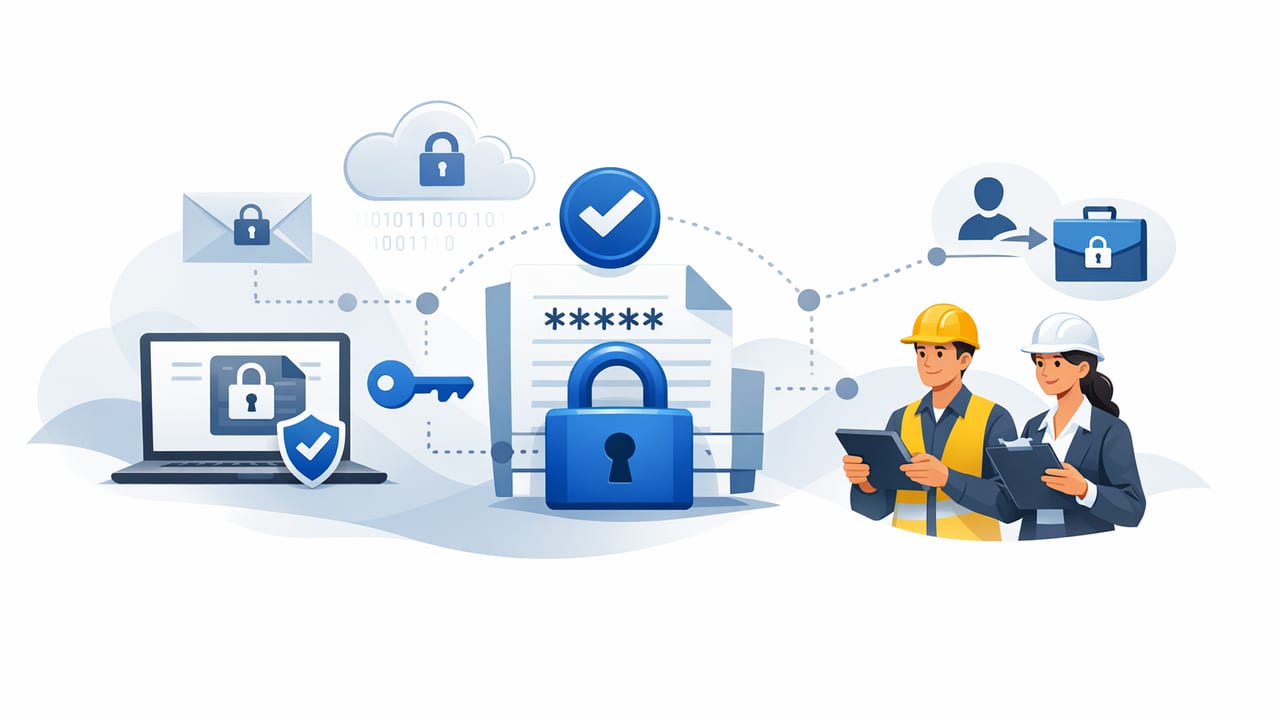
Encrypted secrets sharing for contractors is one of the fastest ways to reduce vendor risk without slowing delivery. Contractors often need temporary access to sensitive assets—API keys, database credentials, SSH keys, signing certificates, or SaaS admin tokens—yet their devices, networks, and security controls are outside your direct control. If you treat contractor access like internal access, you usually over-share. If you treat it like “just send it in chat,” you create an incident waiting to happen.
This guide explains how to share secrets with contractors safely using encryption, least privilege, expiration, and auditability—plus practical patterns you can standardize across engineering, IT, and security teams.
Why contractor secret-sharing is uniquely risky
Contractors introduce a different threat model than employees:
- Unmanaged endpoints: you can’t assume full-disk encryption, EDR, or patch compliance.
- Higher credential sprawl: access is often stitched together quickly across environments.
- Blurred accountability: multiple parties, subcontractors, and shared devices increase exposure.
- Offboarding gaps: access often outlives the contract unless revocation is automated.
The goal isn’t “never share secrets.” It’s to avoid sharing long-lived secrets directly whenever possible, and when you must share, do it in a way that is encrypted, time-bound, minimally scoped, and fully logged.
What counts as a “secret” you should protect
Contractors frequently request items like:
- Production or staging database usernames/passwords
- Cloud access keys (AWS/GCP/Azure), kubeconfigs, service account JSON
- Third-party API keys (payment providers, email, analytics)
- SSH private keys, VPN profiles, wireguard keys
- Signing keys (JWT, SAML, mobile signing, code signing)
In most cases, you should not hand over the “root” credential. Prefer temporary, scoped credentials generated just-in-time (JIT) and revoked automatically.
Anti-patterns to eliminate (even if they feel convenient)
- Plaintext in email, tickets, or chat (including “private” DMs). These systems are searchable and often broadly accessible.
- Shared spreadsheets/docs with “limited access.” Permissions drift, links leak, and copies persist.
- One shared account used by multiple contractors. You lose attribution and can’t rotate without disruption.
- Long-lived API keys without rotation, expiration, or IP/device restrictions.
Rule of thumb: If you can’t confidently answer “who had access, when, and for what purpose,” you’re not sharing secrets—you’re losing control of them.
A practical model for encrypted secret sharing
A secure contractor workflow typically has four pillars:
- Identity first: contractors authenticate with SSO/MFA and are assigned to a dedicated group/role.
- Least privilege: grant only the specific secret(s) needed, scoped to the minimum environment and action.
- Time bounds: access expires automatically (hours/days), with renewals requiring approval.
- Audit + rotation: access is logged; secrets are rotated after the engagement (or automatically).
Encryption is necessary but not sufficient. “Encrypted in transit” won’t save you if the secret is pasted into tools that store it forever. You want end-to-end encrypted distribution and controlled retrieval with logging.
Compare common ways to share secrets with contractors
| Method | Encryption | Expiration | Audit trail | Best use |
|---|---|---|---|---|
| Email / chat paste | Transport only | No | Weak/fragmented | Avoid |
| “One-time” link tools | Usually | Yes | Limited | Low-risk, non-production, last resort |
| Password manager sharing | End-to-end | Sometimes | Moderate | Human logins (SaaS accounts), small teams |
| Secrets manager with RBAC + JIT | Strong | Yes | Strong | API keys, infra secrets, production access |
| Dynamic credentials (ephemeral) | Strong | Yes (built-in) | Strong | DB access, cloud sessions, short engagements |
Recommended approach: don’t share; broker access
The safest pattern is to avoid giving a contractor a reusable secret at all. Instead:
- Broker access through identity (SSO + MFA), not shared credentials.
- Issue short-lived credentials (minutes to hours) that auto-expire.
- Restrict by environment (staging only, or a dedicated contractor sandbox).
- Restrict by capability (read-only vs write, specific endpoints, specific tables).
Examples of “brokered access” include short-lived database users, temporary cloud sessions, or time-bound API tokens with narrow scopes.
Example: time-bound access policy (human-readable)
Use language like this internally so teams have a consistent standard:
- Contractors authenticate via SSO with MFA.
- Access is granted only to a contractor role with explicit approvals.
- Secrets are not shared as plaintext; retrieval must be encrypted and logged.
- All contractor access expires automatically within 7 days (or less) unless renewed.
- After offboarding, rotate any shared credentials and revoke all tokens/sessions.
When you must share a secret directly: do it with end-to-end encryption
Sometimes a contractor needs a configuration value (for example, a staging API key) that can’t easily be generated dynamically. In those cases, use end-to-end encryption tied to the contractor’s public key, and make the secret as low-risk as possible (scoped + time-limited + easily rotated).
Practical example: encrypt a config file to a contractor’s public key
One simple, auditable workflow uses a modern file encryption tool (for example, age) to encrypt a temporary .env file so only the contractor can decrypt it locally.
# 1) Contractor generates an age keypair and sends you their public key
# Their public key looks like: age1... (safe to share)

# 2) You create a minimal, scoped config file (avoid production where possible)
cat > contractor.env <<'EOF'
STAGING_API_BASE=https://staging.api.example.com
STAGING_API_KEY=stg_12345_scoped_key
EOF

# 3) Encrypt the file to the contractor's public key
age -r age1contractorpublickeyhere -o contractor.env.age contractor.env

# 4) Send ONLY the encrypted file (contractor.env.age) via your normal channel
# (email/ticket is acceptable for the ciphertext)

# 5) Contractor decrypts locally
age -d -o contractor.env contractor.env.age
Important controls to add:
- Make the secret short-lived (rotate after delivery, or set an expiry where supported).
- Scope it to staging/sandbox, not production.
- Record the request and approval in a ticketing system for later audit.
- Never reuse the same “contractor key” for future engagements.
Operational checklist: contractor onboarding for secret access
1) Establish a dedicated contractor boundary
- Create contractor-specific identity groups (e.g.,
contractor-frontend,contractor-data). - Segment environments (contractor sandbox, staging, production) and prefer sandbox.
- Use separate accounts/projects where feasible (especially in cloud environments).
2) Use least privilege and “need-to-know” secret design
- Prefer per-contractor credentials over shared credentials.
- Use read-only whenever possible.
- Restrict by IP allowlists or device posture checks if your stack supports it.
- Limit secret visibility: a contractor should never be able to list secrets they don’t need.
3) Add expiration and renewal gates
- Access grants should have an expiry date aligned to the statement of work.
- Renewal should require explicit approval (manager + service owner).
- Automate reminders for upcoming expirations to avoid “emergency” renewals.
4) Require audit logs you can actually use
At minimum, log:
- Who accessed a secret (identity, role, device signals if available)
- What secret was accessed (identifier/path, not the value)
- When it was accessed, from where (IP/region), and via which method (UI/API)
- Whether the secret was updated/rotated and by whom
Then make the logs actionable: alerts for unusual geographies, excessive reads, access outside business hours, and repeated failures.
Offboarding: the step teams skip (and attackers love)
Encrypted secrets sharing for contractors only works if offboarding is disciplined. Use a written runbook and automate as much as possible.
- Disable identity: deactivate SSO account, revoke MFA sessions, terminate active tokens.
- Remove group memberships: contractor roles, repo access, cloud projects, ticketing tools.
- Rotate exposed secrets: anything the contractor could have read should be assumed copied.
- Invalidate SSH keys: remove from authorized_keys, rotate bastion credentials.
- Close the loop: confirm completion in the offboarding ticket with timestamps.
If rotating “everything” sounds expensive, that’s a sign you’re still using broad, long-lived secrets. Moving to scoped and short-lived credentials makes rotation cheaper and less disruptive.
Compliance and governance considerations
Even if you’re not chasing a specific certification, these controls map well to common requirements:
- Access control: documented approvals, RBAC, least privilege
- Cryptographic protection: encryption at rest/in transit, plus end-to-end encryption when distributing secrets
- Auditability: immutable logs, periodic access reviews
- Vendor management: contractor inventory, time-bounded access, and offboarding evidence
Schedule recurring access reviews (monthly/quarterly). Contractor access should be the first place you look for permission creep.
Putting it all together: a simple reference workflow
- Contract request created (scope, environment, duration, data classification).
- Contractor identity provisioned via SSO + MFA; placed in contractor group.
- Secrets access granted via role with expiration (prefer JIT/dynamic credentials).
- If direct sharing is unavoidable, share only ciphertext (public-key encrypted), and set a rotation date.
- Monitor audit logs and alert on anomalies.
- Offboard on end date: disable identity, remove roles, rotate anything exposed, document completion.
Conclusion
Secure contractor access doesn’t require heroics—just consistent mechanics: broker access through identity, minimize and time-bound privileges, encrypt any necessary distribution end-to-end, and rotate on exit. When encrypted secrets sharing for contractors is treated as a standardized workflow (not an exception), you reduce incidents, speed up onboarding, and make audits far less painful.
If you’re formalizing this process, a dedicated secrets management platform with automation and audit-ready controls (such as Vaulify) can help implement these patterns consistently across teams.