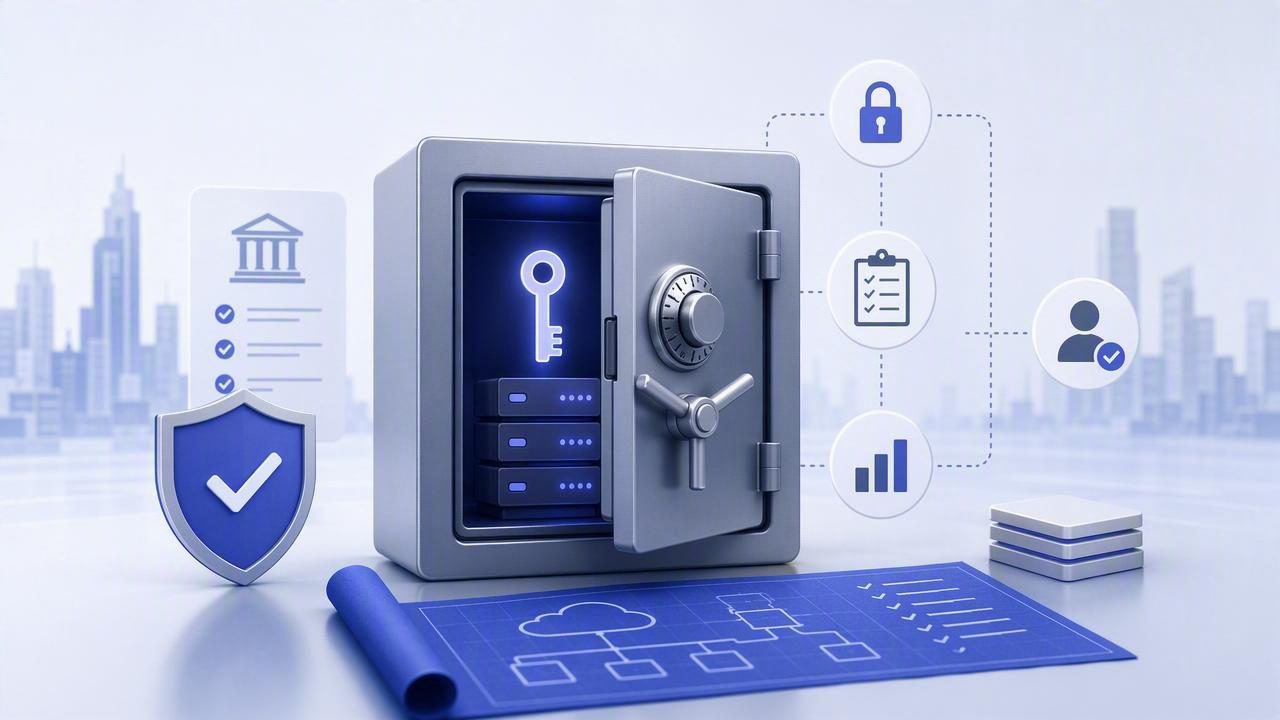
Fintech teams move fast, but regulators do not. If you handle payments, lending, brokerage, or embedded finance, auditors will examine how you store and use credentials. This guide explains compliance ready secret storage for fintech startups: the capabilities auditors expect, a reference architecture you can implement quickly, control mappings to major frameworks, and practical steps to prove your controls with evidence.
Principle: If it’s not automated, it’s not repeatable; if it’s not logged, it didn’t happen.
What “Compliance-Ready” Secret Storage Actually Means
In regulated fintech contexts, compliance readiness isn’t a product label—it’s the consistent ability to demonstrate that sensitive credentials are protected, access is minimized, and activity is recorded. Concretely, you should be able to show:
- Encryption at rest and in transit, ideally with keys in a dedicated KMS/HSM and envelope encryption.
- Strong identity with SSO, SAML/OIDC federation, and least-privilege RBAC tied to groups, not individuals.
- No long-lived secrets for machines. Prefer short-lived, scoped tokens and dynamic credentials.
- Rotation policies with automated enforcement and documented intervals.
- Tamper-evident audit logs for all secret read/write operations, including who, what, when, where.
- Segregation of duties between secret administrators and consumers; approval workflows for high-risk access.
- Environment isolation (dev/test/prod), network segmentation, and deny-by-default policies.
- Backups and recovery with periodic restore tests and documented RPO/RTO.
These principles map well to SOC 2, ISO 27001, PCI DSS 4.0, NIST 800-53, GLBA, NYDFS 500, PSD2/RTS, and similar requirements across jurisdictions.
Reference Architecture for Fintech Secret Management
The following blueprint balances strong controls with startup pragmatism:
Core components
- Secrets control plane: A vault service (managed or self-hosted) with HA, versioning, and sealed by KMS/HSM. Enables policy, auth, audit, rotation, and secret engines.
- KMS/HSM: Separate key management system to manage root keys, provide envelope encryption, and enforce key rotation and access separation.
- Identity provider (IdP): SSO via SAML/OIDC; SCIM for automated provisioning and deprovisioning.
- Workload identity: OIDC or cloud IAM roles for CI/CD, containers, serverless, and VMs to obtain short-lived tokens without static secrets.
- Network controls: Private networking, inbound allowlists, mutual TLS where feasible, and WAF or API gateway for administrative endpoints.
Data flow
- Human users authenticate via SSO; roles and groups map to vault policies. Admin actions require MFA and potentially step-up approval.
- Workloads present federated identity (e.g., OIDC) to the vault, exchanging it for a short-lived token scoped to the needed path.
- Applications retrieve secrets just-in-time at startup or per request; tokens and credentials expire quickly.
- Audit logs stream to a centralized, immutable logging system; alerts trigger on policy violations or anomalous access patterns.
Control Mapping: What Auditors Look For
| Capability | Why It Matters | Example Framework Mapping |
|---|---|---|
| Encryption at rest (KMS/HSM-backed) | Protects secrets even if storage is compromised | PCI DSS 3.5, ISO 27001 A.8.10, SOC 2 CC6/CC7 |
| Least-privilege RBAC | Limits blast radius and insider risk | ISO 27001 A.5.16, SOC 2 CC6.1, NIST AC-6 |
| MFA and SSO for admins | Prevents account takeover | PCI DSS 8.4, ISO 27001 A.6.3, SOC 2 CC6.2 |
| Short-lived tokens; dynamic creds | Eliminates static exposure | PCI DSS 8.3.10, NIST IA/AC controls |
| Automated rotation | Reduces window of compromise | PCI DSS 8.3.x, ISO 27001 A.8.32 |
| Tamper-evident audit logging | Supports forensics and evidence | PCI DSS 10, SOC 2 CC7, ISO 27001 A.8.15 |
| Change management and approvals | Ensures oversight on risk | SOC 2 CC8, ISO 27001 A.8.32/33 |
| Backup and restore tests | Recoverability and continuity | ISO 27001 A.5.30, SOC 2 CC7.3 |
Note: Always align control names and evidence to your specific audit scope and version of the framework.
Implementation Checklist by Stage
Day 0–14: Foundations
- Pick a secrets manager with KMS integration and HA.
- Integrate SSO; enforce MFA for all interactive access.
- Create environments: dev, staging, prod with separate namespaces and keys.
- Define baseline policies: deny-by-default; read-only per service; admin break-glass with approval.
- Enable structured, immutable audit logs; ship to a central log platform.
Day 15–45: Automation
- Adopt workload identity (OIDC/cloud IAM) for CI/CD and compute; remove static repo secrets.
- Automate rotation for databases, cloud IAM keys, and SSH; set sane TTLs (e.g., 15–60 minutes for machine tokens).
- Implement secret versioning and soft-delete; establish backup cadence and test restore.
- Write runbooks: on-call rotation failures, emergency revocation, and access requests.
Day 46–90: Evidence and Hardening
- Turn policies into code; enforce via CI checks and scheduled compliance scans.
- Create dashboards for access anomalies and rotation SLA compliance.
- Run an access review; prune unused secrets and entitlements.
- Dry-run an audit: export policy, logs, rotation reports, and change approvals.
Policy-as-Code: Enforcing What You Expect
Codify guardrails so drift is detectable and fixable via pull requests. For example, an OPA/Rego policy to ensure machine tokens in production expire in under an hour:
package vault.policies

deny[msg] {
  input.environment == "prod"
  input.token_type == "machine"
  input.ttl_minutes > 60
  msg := sprintf("Prod machine token TTL too high: %v minutes", [input.ttl_minutes])
}
Run this in CI against a JSON export of your token configuration and fail builds if it triggers.
CI/CD: Deliver Secrets Without Storing Them
Use OpenID Connect in GitHub Actions (or your CI) to exchange a workload identity for a short-lived vault token at runtime—no static credentials. Here’s a simplified example:
name: build-and-test
on: [push]

jobs:
  build:
    runs-on: ubuntu-latest
    permissions:
      id-token: write
      contents: read
    steps:
      - uses: actions/checkout@v4

      - name: Exchange OIDC for vault token
        env:
          AID_URL: ${{ secrets.ACTIONS_ID_TOKEN_REQUEST_URL }}
          AID_TOKEN: ${{ secrets.ACTIONS_ID_TOKEN_REQUEST_TOKEN }}
        run: |
          # Request an OIDC JWT with an audience the vault trusts
          OIDC_JWT=$(curl -s -H "Authorization: bearer $AID_TOKEN" "${AID_URL}&audience=vault" | jq -r .value)
          # Exchange for a short-lived vault token
          VAULT_TOKEN=$(curl -s -X POST https://vault.example.com/v1/oidc/auth \
            -H "Authorization: Bearer ${OIDC_JWT}" | jq -r .client_token)
          echo "VAULT_TOKEN=${VAULT_TOKEN}" >> $GITHUB_ENV

      - name: Fetch runtime secret
        run: |
          DB_URL=$(curl -s -H "X-Vault-Token: $VAULT_TOKEN" \
            https://vault.example.com/v1/kv/data/payments-api | jq -r .data.data.DB_URL)
          echo "DB_URL=${DB_URL}" >> $GITHUB_ENV

      - name: Run tests
        run: ./scripts/run-tests.sh
This model satisfies least privilege and reduces secret sprawl. Ensure you bind claims (repo, branch, environment) to vault policies for fine-grained access.
Rotation Strategies that Work
- Databases: Prefer dynamic creds per workload with TTL 15–60 minutes; otherwise rotate static creds at least every 90 days with automated cutover and dual-credential windows.
- Cloud IAM keys: Eliminate long-lived access keys; use roles and STS. If unavoidable, rotate every 30 days with detection for unused keys.
- API tokens: Use scopes and short TTLs; rotate on schedule and on risk events (leak, role change, vendor breach).
- SSH: Use certificate-based SSH with short-lived certs; avoid static key distribution.
- Certificates/TLS: Automate issuance via ACME or internal PKI; renew before 2/3 of lifetime.
Evidence Collection: Make Audits Boring
Prepare artifacts in advance and keep them current:
- Policy export: RBAC, paths, and conditions as JSON/YAML; include approvals.
- Rotation reports: Automated summaries showing last rotation date, next rotation due, and exceptions with ticket links.
- Access logs: Immutable, signed logs with user/workload identity, secret path, action, IP, and result; maintain 12+ months retention where required.
- Change records: PR links, peer reviews, and change tickets for policy updates and high-risk changes.
- Restore test reports: Screenshots or logs proving periodic backup restore tests and outcomes.
Bundle these into an auditor-friendly package per environment, with timestamps and owners.
Common Pitfalls (and How to Avoid Them)
- Copying secrets into config files: Use environment injection or sidecar agents; scan repos to block secret commits.
- One-size-fits-all roles: Break down roles by service and operation (read/write); deny wildcard paths in production.
- Unbounded tokens: Enforce TTLs and max TTLs; disable renewable tokens in production unless justified.
- Shadow secrets: Inventory periodically; remove unused secrets and stale versions.
- Ignoring operational runbooks: Define on-call procedures for rotation failures, token revocation, and incident response.
- Vault sprawl: Centralize or federate with consistent policy-as-code; avoid ungoverned team-level stores.
KPIs to Prove Control Effectiveness
- Rotation SLA: Percentage of secrets meeting rotation policy (target: >98%).
- Static secret count: Number of long-lived machine secrets (target: 0).
- Access anomalies: Unusual reads by identity, volume, or time-of-day (investigate within 24 hours).
- Policy coverage: Percentage of services with policy-as-code checks in CI (target: 100%).
- Mean time to revoke: From incident detection to credential invalidation (target: minutes, not hours).
Minimal Documentation Set for Auditors
Maintain living documents in your repo or wiki:
- Secrets Handling Policy: Scope, classification, roles, required controls, and rotation cadences.
- Architecture Diagram: Data flows, trust boundaries, and identity providers.
- Access Request Procedure: How engineers request and obtain time-bound access with approvals.
- Backup & Restore Procedure: Frequency, encryption, key custody, and last test date.
- Incident Playbooks: Secret leakage response, forced rotations, and evidence preservation.
Security-by-Design Tips for Fintech
- Customer-managed keys (CMK): For enterprise customers, support encryption with their KMS keys to simplify B2B reviews.
- Data minimization: Store tokens with least scope; prefer tokenization or delegated auth when possible.
- Regional isolation: For GDPR and data residency, keep secret storage and KMS in-region per tenant.
- Production access friction: Implement just-in-time elevation with approvals and automatic expiry.
Putting It All Together
Compliance-ready secret storage isn’t about buying a tool; it’s about operating predictable controls with verifiable evidence. Start with a KMS-backed vault, federate identity for humans and workloads, kill long-lived secrets, automate rotation, and continuously export evidence through policy-as-code and immutable logs. If auditors can trace a secret’s lifecycle—who created it, who accessed it, how it’s rotated, and how you’d revoke it in minutes—you’re in strong shape.
Teams that implement these patterns early move faster later: onboarding partners is easier, due diligence questionnaires are lighter, and incident response is crisper. Tools like Vaulify can help unify these practices with automation and compliance reporting, but the foundations above will serve you well regardless of the platform you choose.