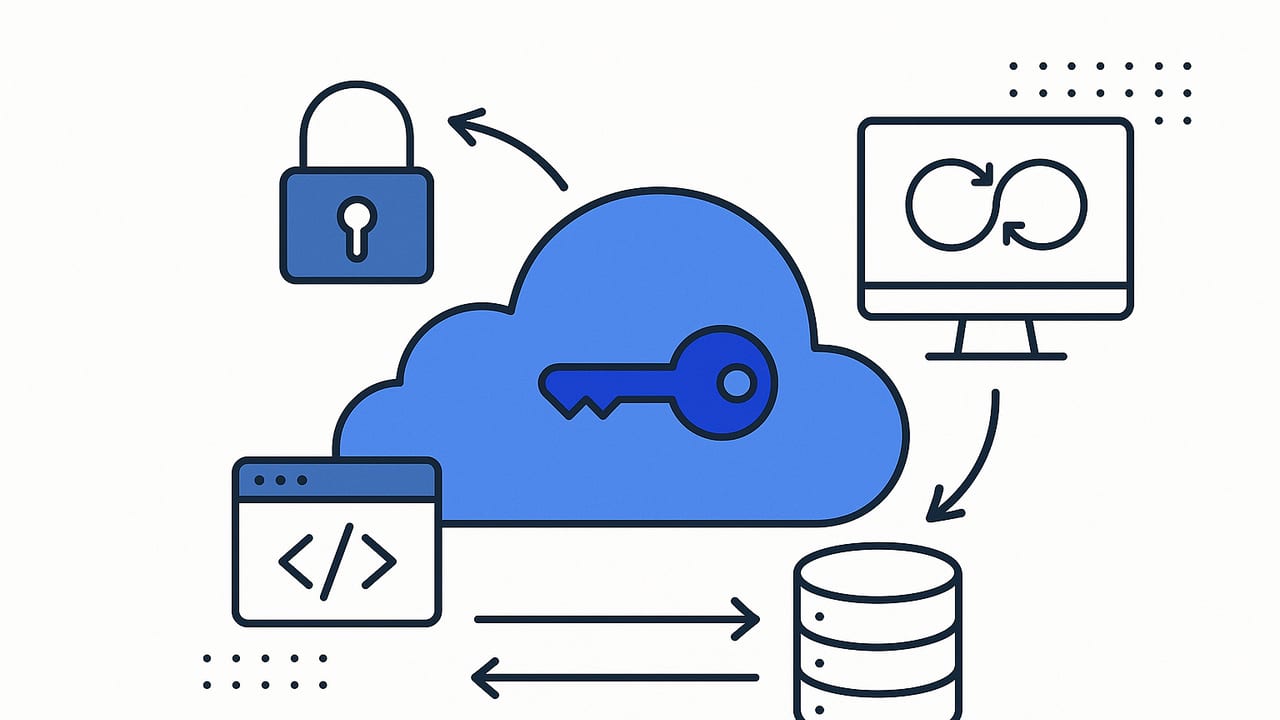
Rotating secrets in the cloud should not pause production traffic, terminate live sessions, or force emergency redeploys. Whether you manage API keys, database passwords, OAuth client secrets, or certificates, the goal is consistent: execute cloud secrets rotation with zero downtime deployments while maintaining strict security guarantees. This guide distills proven patterns, runbooks, and reference snippets to help platform, SRE, and security teams deliver continuous rotation without interrupting customers.
“If your security control requires an outage, it will be deferred; if it’s seamless, it will be adopted.”
Why Zero Downtime Matters for Secrets Rotation
- Security posture: Short-lived and regularly rotated secrets reduce blast radius and limit usefulness of stolen credentials.
- Reliability: Poorly coordinated rotations cause connection storms, 5xx spikes, and cascading failures. Zero downtime avoids compounding incidents.
- Compliance: Controls often mandate periodic rotation; doing so without outages makes the control operationally feasible.
- Developer velocity: Automated, non-disruptive rotation prevents ticket queues, manual hotfixes, and off-hours change windows.
Core Principles for Zero-Downtime Rotation
- Dual availability: Old and new secrets must overlap for a controlled handover. Services validate both during a defined grace period.
- Decouple generation from activation: Generate and distribute new secrets first; switch validation last.
- Idempotent reload: Applications must reload secrets without process restarts or traffic loss (e.g., hot config reloads, connection pool draining).
- Time-bound grace period: Define precise TTLs, back-out windows, and automatic invalidation when the window ends.
- Atomic cutover: The authority of truth (auth server, DB, API gateway) flips validation from old+new to new-only in one action.
- Observability: Emit metrics and logs around key events: distribution success, validation acceptance, failure rates, and residual usage of old credentials.
Reference Architecture Patterns
1) Blue/Green Secrets (Dual-Key Strategy)
Maintain two secrets per principal (e.g., keyA and keyB). At any point:
- One is active for creation/signing.
- Both are valid for verification during the grace window.
Flow: create new keyB → distribute → services start using keyB → authority validates keyA+keyB → retire keyA after no usage detected.
Best for: JWT signing keys, HMAC secrets, API keys issued to internal services.
2) Staggered Rotation with Connection Pool Draining
For database passwords and queue credentials, overlap credentials while draining old connections.
- Create user_new with identical privileges.
- Distribute user_new to services.
- Rotate service config and drain pools: new connections use user_new; old ones are allowed to finish.
- After a defined window, revoke user_old and kill lingering sessions if any remain.
Best for: RDBMS (PostgreSQL/MySQL), message brokers (Kafka/RabbitMQ) that support concurrent principals.
3) Short-Lived, On-Demand Credentials
Prefer ephemeral secrets via brokered identity (OIDC/JWT to STS). Services obtain short-lived tokens at startup and refresh before expiry. Rotation becomes continuous and inherent.
Best for: Cloud IAM roles, database brokers (e.g., IAM auth), SaaS APIs supporting token exchange.
4) Sidecar and Watcher-Based Reload
Use a sidecar or agent to fetch new secrets and signal the app to reload without restart. Common approaches:
- File mount updates with inotify-triggered reload
- HTTP admin port signal (e.g.,
/reload) - SIGHUP to gracefully refresh configs
Quick Comparison of Rotation Strategies
| Pattern | Downtime Risk | Complexity | Notes |
|---|---|---|---|
| Blue/Green Secrets | Low | Medium | Requires dual validation period |
| Pool Draining | Low | Medium | Needs session visibility/kill capability |
| Short-Lived Tokens | Very Low | High | Shift to identity brokering; fewer static secrets |
| Hot Reload via Sidecar | Low | Low-Medium | App must support non-disruptive reload |
Database Rotation Example: PostgreSQL Without Interruptions
Objective: Rotate a production PostgreSQL user password with zero downtime deployments.
Prerequisites
- Two roles:
app_oldandapp_new, same privileges - Secrets manager capable of distributing new credentials
- Application supports hot reload or seamless config update
Runbook
- Create new role:
-- as admin CREATE ROLE app_new LOGIN PASSWORD 'S3cure#Temp' INHERIT; GRANT SELECT, INSERT, UPDATE, DELETE ON ALL TABLES IN SCHEMA public TO app_new; ALTER DEFAULT PRIVILEGES IN SCHEMA public GRANT SELECT, INSERT, UPDATE, DELETE ON TABLES TO app_new; - Distribute credentials: Publish
app_newto the vault and propagate to services. - Hot switch connections: Update service config and reload gracefully (no process kill). For example, with a Node.js app:
// Pseudocode app.on('SIGHUP', async () => { const { user, pass } = await fetchSecret('db/app_new'); await dbPool.reconnect({ user, password: pass }); // new connections use app_new }); - Drain old sessions: Let existing connections on
app_oldcomplete. Monitor usage:SELECT usename, count(*) FROM pg_stat_activity WHERE usename IN ('app_old','app_new') GROUP BY usename; - Revoke and clean up: When
app_oldhas zero sessions for N minutes, revoke or drop:REASSIGN OWNED BY app_old TO app_new; DROP OWNED BY app_old; DROP ROLE app_old;
Tip: For RDS/Aurora, consider IAM database authentication or AWS Secrets Manager’s rotation lambda as a broker, while still applying the dual-user pattern during migration.
CI/CD Integration and Automation
Integrate rotation into pipelines to make it predictable and repeatable.
- Pre-rotation check: Validate service readiness (hot reload endpoint responsive, config templates present).
- Generate and store: Create new secret version; tag with metadata (
version,expires_at,grace_until). - Distribute and verify: Push to runtime environments; perform smoke checks (
healthzwith dependency probes). - Cutover: Flip validation to accept new+old, then new-only after the grace period.
- Post-rotation audit: Emit evidence: change IDs, approvers, and cryptographic fingerprints for compliance.
# Example GitHub Actions fragment
jobs:
  rotate:
    runs-on: ubuntu-latest
    steps:
      - name: Generate new secret
        run: ./scripts/gen_secret.sh --name api_hmac --out new.json
      - name: Store in vault
        run: ./scripts/vault_put.sh api_hmac @new.json
      - name: Trigger reload
        run: curl -fsS http://service-admin/reload
      - name: Flip validation
        run: ./scripts/enable_dual_validate.sh api_hmac --window 30m
Kubernetes Playbook for Zero Downtime Rotation
Kubernetes provides native primitives for seamless updates.
Key Techniques
- Mount versioned secrets: Use projected volumes; avoid environment variables for secrets that must rotate at runtime.
- Reloader sidecar: Watch mounted files and send SIGHUP to the app.
- PodDisruptionBudget + RollingUpdate: Ensure capacity during reload waves.
Example: Secret Mount + Reloader
apiVersion: v1
kind: Secret
metadata:
  name: db-credentials-v2
stringData:
  username: app_new
  password: S3cure#Temp
---
apiVersion: apps/v1
kind: Deployment
metadata:
  name: orders-api
spec:
  replicas: 4
  strategy:
    type: RollingUpdate
    rollingUpdate:
      maxUnavailable: 0
      maxSurge: 1
  template:
    metadata:
      annotations:
        secret.reloader.stakater.com/reload: "db-credentials-v2"
    spec:
      containers:
        - name: app
          image: ghcr.io/acme/orders-api:stable
          volumeMounts:
            - name: db-credentials
              mountPath: /etc/secrets/db
              readOnly: true
          env:
            - name: DB_CONFIG_PATH
              value: /etc/secrets/db
        - name: reloader
          image: stakater/reloader:latest
      volumes:
        - name: db-credentials
          secret:
            secretName: db-credentials-v2
When the Secret updates to a new version, the reloader notifies the application to re-establish connections using the new credentials, preserving live traffic. Combine this with dual-user database rotation for the full zero downtime path.
Certificate and Key Rotation Without Traffic Drops
- Serve both chains temporarily: For TLS cert renewals, preload the new cert and key alongside the old one in the listener and prefer the new via Server Name Indication.
- Hot reload proxies: Use
nginx -s reload, Envoy hot restart, or HAProxy seamless reload to avoid connection resets. - Pinning considerations: Coordinate HPKP-like pinning or certificate pinning in mobile apps prior to CA changes.
# NGINX hot reload
cp new.crt /etc/nginx/certs/site.crt
cp new.key /etc/nginx/certs/site.key
nginx -t && nginx -s reload
Observability: What to Measure
- Rotation success rate: Percentage of services acknowledging the new secret version within the window.
- Residual old-secret usage: Requests or connections still using the old credential versus new.
- Error budgets: 5xx rate, connection errors, and auth failures during the event.
- Latency impact: p95/p99 before, during, after rotation.
Emit structured logs with fields like secret_name, version, event, and actor to streamline audits and incident analysis.
Common Pitfalls (and Fixes)
- Env var secrets that never refresh: Switch to file mounts or dynamic providers; implement signal-driven reloads.
- Single principal without overlap: Always introduce a second credential or an issuer that validates multiple keys.
- Long-lived connections: Add max connection lifetimes; implement pool draining and retry logic.
- Hidden consumers: Inventory all integrations. Tag secrets with ownership and scan logs to discover unexpected usage before revocation.
- Clock skew: If using expiring tokens, ensure NTP sync across services to avoid premature expiry.
- Missing rollback: Preserve old secret until error rates stabilize; define an explicit revert step in the runbook.
Security and Compliance Mapping
- Least privilege: Issue scoped credentials per service; rotate independently to minimize blast radius.
- Segregation of duties: Separate secret generation from approval and activation steps.
- Evidence and traceability: Store rotation artifacts (hashes, approvers, timestamps) for audits under SOC 2, ISO 27001, PCI DSS, and HIPAA.
- Automated policy enforcement: Define maximum secret age, required grace periods, and minimum overlapping windows as code.
Putting It All Together: A Minimal End-to-End Run
- Plan: Select the strategy (e.g., Blue/Green + pool draining for databases). Define window, SLOs, and rollback.
- Prepare: Create new credential or key; configure validation to accept old+new.
- Distribute: Push to environments; trigger hot reloads; verify with targeted smoke tests.
- Cut over: Shift writers first, then readers if applicable; monitor residual usage of old secret.
- Retire: Revoke old secret when residual usage hits zero within the window; archive evidence.
- Review: Analyze metrics, document lessons, and schedule the next rotation before max age.
FAQ
Does “zero downtime” mean no errors at all?
Practically, it means no customer-impacting outage and SLO adherence. A small, transient increase in connection churn may occur if reloads coincide, but should remain under error budgets.
What if a third-party API doesn’t support dual validation?
Use overlapping client apps or accounts, move traffic gradually via routing rules, and confirm new credentials before revoking old. If unsupported, coordinate maintenance windows with retry-safe clients.
How often should I rotate?
Static credentials: 30–90 days depending on risk. Prefer replacing static secrets with short-lived tokens where possible to make rotation continuous.
Delivering cloud secrets rotation with zero downtime deployments is chiefly about overlap, orchestration, and observability. Adopt dual secrets or short-lived credentials, build hot reload paths, and automate verification with clear SLOs. For teams seeking a streamlined way to manage policies, rotation windows, and audit evidence across environments, platforms like Vaulify can help integrate these patterns without heavy custom tooling.