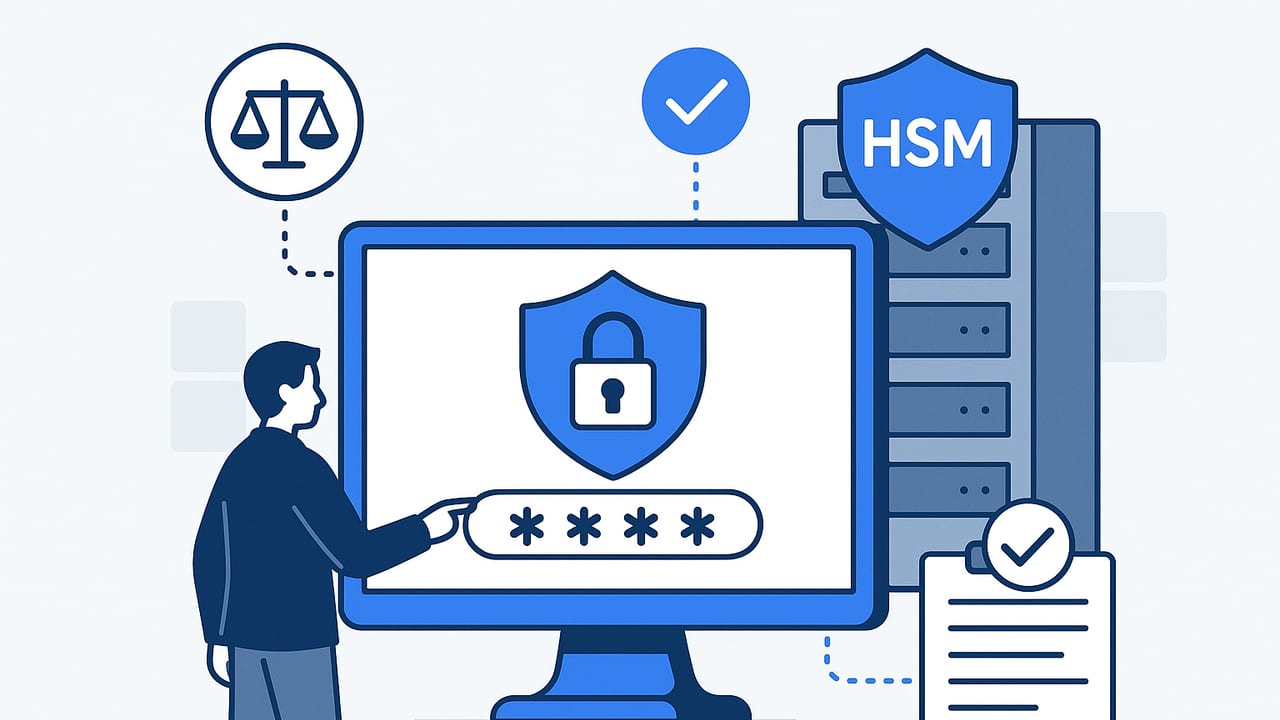
If you operate in healthcare, financial services, government, energy, or pharmaceuticals, the choice of an on premises password manager for regulated industries shapes your security posture, audit readiness, and operational resilience. This guide explains why on‑premises matters, the controls auditors expect, and how to evaluate and deploy a platform that aligns with stringent compliance frameworks without sacrificing usability.
Why On‑Premises Still Matters
Cloud-native tools dominate many IT categories, but regulated organizations often face requirements that tilt the decision toward on‑premises or self‑hosted solutions:
- Data residency and sovereignty: Regulations or contracts may require secrets and logs to remain within specific facilities or jurisdictions.
- Custom cryptographic controls: Integration with on-site HSMs and FIPS-validated modules is easier when the control plane and data plane live in your environment.
- Air-gapped or restricted networks: Industrial control systems, lab environments, or classified networks may prohibit external connectivity.
- Vendor and supply-chain risk: Self-hosting reduces exposure to multi-tenant risk and third-party operational incidents, though it increases internal responsibility.
- Audit traceability: Direct access to raw logs, database storage, and key custody provides stronger evidence for auditors and investigators.
Core Requirements to Expect (and Prove)
Security Foundations
- Strong encryption at rest and in transit: AES‑256 or equivalent for data at rest; TLS 1.2+ (ideally 1.3) with modern cipher suites. Support for FIPS‑validated crypto where mandated.
- Hardware-backed key management: External KMS/HSM support (PKCS#11) for master keys, split knowledge/unseal keys, and dual control workflows.
- Granular access control: RBAC or ABAC with least privilege, approval workflows, and time-bound access; enforce MFA/PIV/CAC where applicable.
- Comprehensive auditing: Immutable, tamper-evident logs streaming to your SIEM; retention aligned with legal requirements; map events to user identity, not just IPs.
- Secret lifecycle automation: Versioning, automatic rotation, check-out/check-in for shared credentials, just-in-time access, and break‑glass procedures.
Compliance Mapping
- HIPAA: Access controls, audit controls, integrity safeguards, and key management align with 45 CFR 164.312; signable BAAs may be relevant with third parties.
- PCI DSS: Credential rotation, privileged access restrictions, and logging mapped to requirements such as 7, 8, and 10; tamper-evident logs are essential.
- NIST SP 800‑53 / 800‑171: Controls like AC‑2, AC‑6, AU‑2/6, IA‑2, SC‑12/13 (crypto), and CM‑6 (config) often apply to government-aligned programs.
- SOX and GLBA: Demonstrable internal controls over privileged access and evidence of change management are critical for financial services.
- GDPR: Data minimization, purpose limitation, and localization can necessitate on‑prem hosting with data subject access workflows.
Architecture Patterns for Self‑Hosted Password Managers
Reliable deployment is as much about architecture as feature checklists. Consider these patterns:
- Three-tier isolation: Separate the web/UI tier, API/logic tier, and storage/DB on segmented subnets with minimal trust; deny-by-default north-south and east-west traffic.
- HSM-backed root of trust: Store master keys in an on-site HSM; use envelope encryption for secret records; enforce dual control for key export or rotation.
- High availability and fault domains: At least three nodes per cluster across fault domains; synchronous replication for RPO≈0 and quorum-based failover.
- Immutable logging pipeline: Forward logs via TLS to a WORM-capable store or SIEM; consider hash chaining or signing for tamper evidence.
- Zero-trust access: Mutual TLS between services; device posture checks for administrators; short-lived tokens with constrained scopes.
- Secrets as code: Manage policies and configuration in version control; adopt change-review gates like pull requests and approvals.
On‑Prem vs. Cloud: What Changes for Regulated Workloads?
| Criterion | On‑Premises Password Manager | Cloud Alternative |
|---|---|---|
| Data residency/control | Full control; localize storage and logs | Depends on regions; shared responsibility |
| HSM/KMS integration | Native to on-site HSMs and FIPS modules | Often via cloud KMS; external HSMs vary |
| Network posture | Supports air‑gap and restricted egress | Requires stable outbound connectivity |
| Compliance attestation | You provide evidence; fine-grained access to artifacts | Provider offers attestations; some controls abstracted |
| Latency & offline ops | Local performance; offline workflows possible | Internet dependency; regional latency |
| Operational overhead | Higher: patching, backups, monitoring | Lower: provider manages platform |
| Cost model | CapEx/OpEx mix; infra + staff | Mostly OpEx subscription |
| Vendor lock‑in | Mitigated via open standards and exportable formats | APIs/SDKs may reduce, but data egress varies |
| Incident response | Direct access to systems for forensics | Provider-assisted IR; ticket-driven access |
Integration Checklist
- Identity and SSO: SAML or OIDC with on-prem IdPs (AD FS, Keycloak), SCIM for provisioning/deprovisioning, and support for MFA methods mandated by policy.
- Directory services: AD/LDAP groups mapped to vault roles; nested group support and attribute-based rules where possible.
- Privileged access flows: Check-out with session recording (when integrated with PAM), automatic rotation on check-in, and ticketing system approvals.
- DevOps toolchains: Native plugins or API access for CI/CD systems, infrastructure-as-code tools, and container platforms.
- Monitoring and SIEM: Syslog and webhook export; CEF or JSON formats; correlation IDs for end-to-end traceability.
Operations: Making Auditors and Engineers Happy
- Backups and DR: Daily encrypted backups with key separation, quarterly restore tests, and offsite storage; document RTO/RPO and demonstrate results.
- Patching cadence: Classify fixes (security vs. feature), maintain a maintenance window, and support blue/green or rolling upgrades.
- Key rotation strategy: Rotate wrapping keys on a fixed cadence; rotate secrets based on sensitivity, not just age; use canary rotations to catch failures safely.
- Segregation of duties: Admins who manage policy should not be able to view secrets; enforce via role separation and cryptographic controls.
- Break‑glass procedure: Offline recovery with auditable steps, emergency accounts, and post‑incident reviews; test at least annually.
Best practice: treat your password manager as a Tier‑0 system. Apply the same rigor you would to domain controllers, HSMs, and core identity services.
Example: Policy‑as‑Code and Rotation
Below is a simplified, platform-agnostic example showing a team policy, a rotation rule, and a service account constraint. Adapt the schema to your chosen product.
# policy.yaml
version: 1
groups:
  - name: finance-ops
    members:
      - alice@corp.example
      - bob@corp.example
roles:
  - name: reader
    permissions: [secrets.read, audit.read]
  - name: writer
    permissions: [secrets.read, secrets.write, secrets.rotate]
  - name: admin
    permissions: [secrets.*, policy.*, keys.rotate, audit.*]
bindings:
  - group: finance-ops
    role: writer
    scope: vaults/finance/*
constraints:
  - name: mfa-required
    appliesTo: [interactive]
    rules:
      - type: mfa
        methods: [webauthn, totp, piv]
  - name: checkout-time-limit
    appliesTo: [shared-credentials]
    rules:
      - type: ttl
        value: 2h
rotation:
  - target: secrets/db/prod
    method: postgres
    schedule: "0 */6 * * *"   # every 6 hours
    window: 5m
    retry: 3
    postHooks:
      - type: notify
        channel: security-ops
serviceAccounts:
  - name: cicd-deployer
    scopes: [secrets.read]
    tokenTTL: 10m
    network:
      allowCIDR: [10.10.0.0/16]
    approvals:
      required: false
Key points demonstrated:
- Separation of roles: Readers, writers, and admins have clearly bounded permissions.
- Context-aware controls: MFA for interactive sessions; short-lived tokens for automation.
- Automated rotation: Frequent rotation reduces credential lifespan and lateral movement risk.
- Network scoping: Service account access limited to approved subnets.
Migration and Coexistence Strategy
- Inventory and classification: Catalog secrets, owners, rotation status, and dependencies; classify by system criticality and regulatory scope.
- Pilot with a bounded domain: Choose a single line of business or environment (e.g., non‑prod) to validate HA, logging, and rotation.
- Parallel run and guardrails: Mirror critical secrets; enable read-only policies first; run canary rotations to catch integration issues.
- Decommission with proof: Remove legacy vaults or spreadsheets only after dual verification; export audit artifacts for the change record.
Common Pitfalls to Avoid
- Ignoring application dependencies: Rotating a database password without updating connection pools can cause cascading failures; use phased cutovers.
- Over‑privileged service accounts: Limit scopes and TTLs; rotate machine credentials frequently and prefer ephemeral access.
- Unvalidated HA: Many outages occur during planned maintenance. Practice failover and document operator runbooks.
- Unstructured audit data: If logs are not normalized, investigators waste time. Standardize fields like user, subject, action, result, object path, and correlation ID.
- One-size-fits-all policies: Apply different controls for regulated vs. general workloads to avoid friction and shadow IT.
What to Ask Vendors (or Your Internal Platform Team)
- Crypto and key custody: Can master keys live in our HSM? Are envelope keys rotated separately? Is FIPS validation available where required?
- Access governance: How do you enforce least privilege, approvals, and time-bound access across humans and machines?
- Audit depth: Are logs tamper-evident? Can we stream to our SIEM in real time? What fields are included by default?
- Operational resilience: What are the tested RTO/RPO? How are upgrades performed without downtime?
- Interoperability: Which identity providers, PAM suites, CI/CD tools, and directories are supported natively?
- Data portability: How can we export secrets and policies in a vendor-neutral format? Is there a documented rollback path?
Cost and Resourcing Considerations
On‑premises platforms shift responsibility to your team. Budget for:
- Platform engineering time: Installation, patching, monitoring, and incident response.
- Infrastructure: Compute, storage, HSM licensing, backups, and test environments.
- Training: Operator runbooks, security champion enablement, and developer onboarding for API usage.
- Compliance operations: Evidence collection, periodic control testing, and tabletop exercises.
While the total cost of ownership can be higher than SaaS, the tradeoff is control over data, keys, and audit artifacts, which is often non‑negotiable in regulated settings.
Putting It All Together
Selecting an on premises password manager for regulated industries is a balance between rigorous control and practical usability. Focus on verifiable security controls (HSM-backed keys, immutable logs, zero-trust networking), operational maturity (HA, tested DR, safe rotations), and integrations that embed the vault into your identity, CI/CD, and monitoring stack. Start small, automate policy-as-code, and prove your setup with real recovery drills and auditor-friendly evidence.
If you are exploring options in this space, consider evaluating platforms that emphasize strong automation, compliance alignment, and straightforward operations; for example, Vaulify offers an approach centered on secure secrets management with an emphasis on ease of use and auditability.