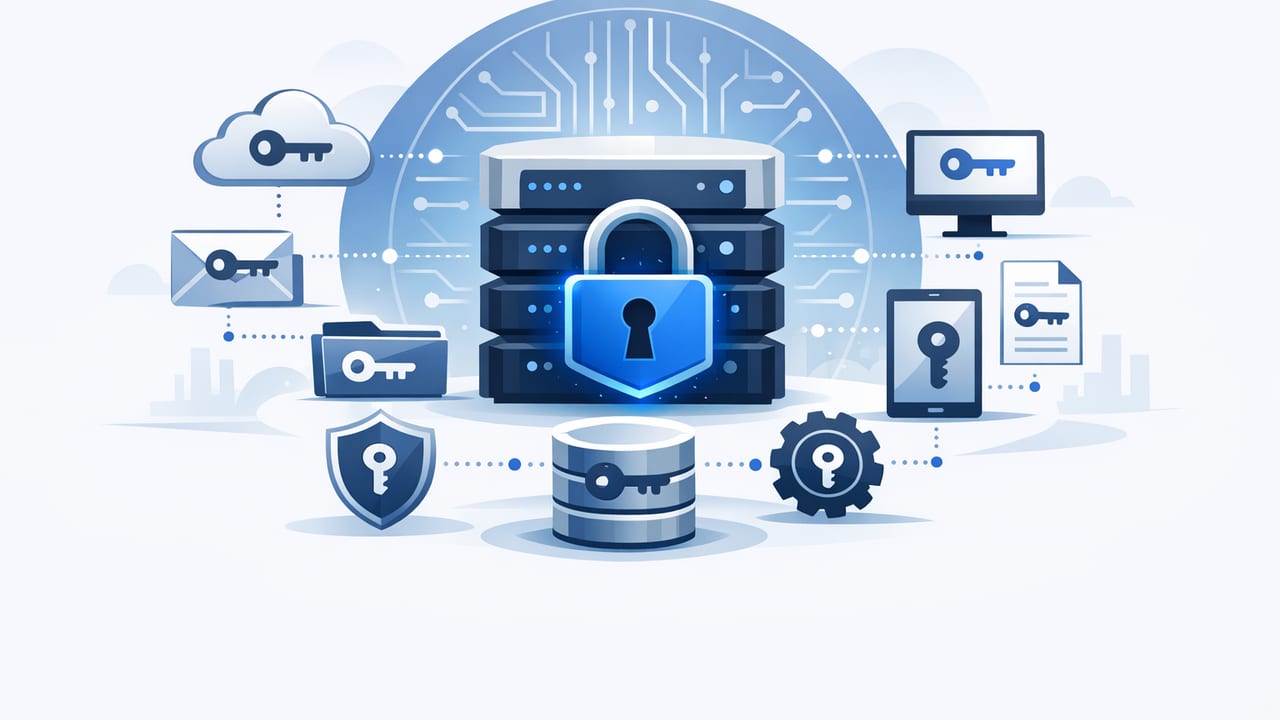
Secrets (passwords, API keys, tokens, certificates, encryption keys, database credentials) are the connective tissue of modern systems—and one of the most common causes of preventable breaches. The problem rarely starts as “bad security.” It starts as convenience: a token in a config file, a shared admin password, a long-lived key in a CI variable, a spreadsheet of credentials, or “temporary” secrets that become permanent.
A centralized secrets management platform addresses this systematically by making secure storage, controlled access, and automated lifecycle management the default. Instead of every team inventing its own pattern, you standardize how secrets are created, distributed, rotated, audited, and revoked across applications, pipelines, and humans.
This guide explains what “centralized” really means, the architecture that makes it work, and a practical checklist to evaluate or design a platform that fits your environment and compliance needs.
Why centralize secrets in the first place?
Organizations usually centralize after experiencing at least one of these pain points:
- Secrets sprawl: credentials scattered across repos, wikis, CI tools, chat, and laptops.
- Over-permissioned access: shared credentials or broad IAM policies used “to keep things moving.”
- Slow incident response: when a key leaks, nobody knows where it’s used or how quickly it can be rotated.
- Audit headaches: lack of evidence for “who accessed what, when, and why.”
- Rotation backlog: long-lived keys survive for months/years because rotation is manual and risky.
A centralized approach reduces risk by making security features like least privilege, short-lived credentials, policy-based access, and automation consistent across teams and environments.
What a centralized secrets management platform should do
Centralization is not just “one database of secrets.” A robust platform provides a set of capabilities that work together:
- Secure storage: encryption at rest, strong key protection, and safe backup/restore processes.
- Authentication & authorization: integrate with your identity provider (SSO), support workload identity, and enforce policy-driven access.
- Secret delivery: provide secrets to apps and CI/CD without exposing them in logs, files, or environment dumps.
- Lifecycle management: rotation, expiration, revocation, versioning, and safe rollbacks.
- Auditing & reporting: immutable logs, searchable events, and exportable evidence for compliance.
- Automation: APIs, Terraform/providers, webhooks, and integrations with runtime platforms (containers, serverless, VMs).
Reference architecture: how centralized secrets work end to end
While implementations vary, most architectures share common building blocks:
1) A policy-enforced secrets store
This is the core system that encrypts secrets and enforces access rules. Good platforms separate storage from policy so you can change permissions without rewriting secrets.
Key design points:
- Encryption: envelope encryption (data keys protected by a master key), plus periodic re-keying procedures.
- Namespaces/projects: isolate teams, apps, and environments (dev/stage/prod).
- Versioning: support multiple versions to enable rotation without downtime.
2) Identity: human and workload authentication
Centralization fails when teams revert to shared passwords or static tokens. The platform should support:
- Human access via SSO: map groups/roles to policies; require MFA.
- Workload identity: authenticate applications using platform-native identity (Kubernetes service accounts, cloud workload identity, or signed JWTs).
- Short-lived sessions: reduce the blast radius if a token is stolen.
3) Secret distribution patterns
There are three common ways to deliver secrets to applications safely:
- Pull at runtime: app fetches secrets on startup (or on demand) using workload identity.
- Sidecar/agent injection: a local agent fetches and refreshes secrets; the app reads from a local file/socket.
- CI/CD injection: pipeline fetches secrets just-in-time for deployment steps (not stored as long-lived variables).
Each pattern can be secure; the best choice depends on latency, operational complexity, and how often secrets rotate.
Centralized vs. decentralized approaches (quick comparison)
| Approach | Pros | Cons | Best for |
|---|---|---|---|
| Scattered env vars / CI variables | Fast to start | No consistent audit, hard rotation, easy leakage into logs | Prototypes only |
| Per-team secret stores | Team autonomy | Duplicated policies, inconsistent controls, hard to govern | Very small orgs with strong discipline |
| Centralized secrets management platform | Consistent policy, automation, auditability, easier incident response | Requires rollout plan and integration work | Any org operating multiple apps/environments |
Security controls to require (non-negotiables)
When evaluating a centralized secrets management platform, treat these as baseline requirements:
Access control and policy
- Least privilege: fine-grained policies (by path, environment, action: read/write/list).
- Separation of duties: ability to split admin functions (policy admins vs. secret owners vs. auditors).
- Break-glass workflows: time-bound emergency access with approvals and strong logging.
Audit and evidence
- Immutable logs: record read events (not just writes), policy changes, auth events, and failures.
- Export/integration: ship events to your SIEM for detection and retention.
- Reports: demonstrate rotation cadence, access review completion, and compliance controls.
Lifecycle automation
- Rotation: scheduled or event-based rotation; support for zero-downtime rollovers (old+new valid during transition).
- Revocation: immediate invalidation when compromise is suspected.
- Expiry: enforce maximum age for high-risk secrets (tokens, CI credentials).
Reliability and safety
- High availability: secrets access is on the critical path for apps.
- Disaster recovery: tested restore procedures; clear RPO/RTO targets.
- Rate limiting and abuse protection: prevent credential stuffing and denial-of-service.
Practical implementation patterns (with examples)
Pattern A: Runtime fetch with short-lived identity
The application authenticates using workload identity, requests the secret, and caches it in memory. Prefer this when you can tolerate a small startup dependency and want tight control with minimal moving parts.
# Pseudocode: fetch secret at startup using workload identity
client = SecretsClient(auth="workload_identity")

# Read only what you need, scoped by environment/app
db_password = client.read("prod/payments/db/password")

db = connect(host="db.prod", user="payments", password=db_password)
Tips: avoid printing secrets in error logs; implement retries with jitter; use a minimal cache TTL and re-fetch on auth failures.
Pattern B: Agent/sidecar injection for rotation without restarts
If you rotate database passwords or certificates frequently, a sidecar can refresh a file on disk that the app reloads. This reduces redeploy frequency.
# Example file layout written by an agent
/run/secrets/app.env
/run/secrets/tls.crt
/run/secrets/tls.key
Pair this with app reload hooks (SIGHUP or config reload endpoints) so you can rotate without downtime.
Pattern C: CI/CD just-in-time secrets for deployments
CI/CD systems are frequent leakage points because logs, artifacts, and build caches can unintentionally expose secrets. Prefer just-in-time retrieval per job step, never storing long-lived secrets as “project variables” unless absolutely required.
# Pseudocode: CI job step
TOKEN=$(secretsctl auth --oidc)
export KUBE_CONFIG=$(secretsctl read --token $TOKEN prod/cluster/kubeconfig)

deploy --kubeconfig "$KUBE_CONFIG"
Tips: mask outputs; disable command echo when handling secrets; ensure the token is short-lived and job-scoped.
Selection checklist for a centralized secrets management platform
Use this checklist to compare solutions or validate an internal design. The goal is not “most features,” but the right features that reduce operational risk.
1) Identity and access
- Does it integrate with your IdP (SAML/OIDC) for SSO?
- Does it support workload identity for your runtime (Kubernetes, VMs, serverless)?
- Can you enforce least-privilege policies without fragile exceptions?
- Can you run periodic access reviews and export evidence?
2) Secret lifecycle and automation
- Does it support rotation workflows (manual approval, scheduled, or event-driven)?
- Can it manage versions and allow safe rollbacks?
- Is there an API/CLI/SDK for automation (provisioning, onboarding, rotation)?
- Can you detect unused secrets and enforce expirations?
3) Operational and security posture
- Is HA/DR well-defined and tested?
- Are audit logs tamper-resistant and easy to query?
- Is there strong tenant/project isolation?
- Does it support rate limiting, IP allowlists, and anomaly detection hooks?
4) Developer experience (DX)
- Are integrations and docs clear enough to standardize across teams?
- Can developers self-serve within guardrails (templates, onboarding flows)?
- Does it fit your delivery patterns (runtime pull, sidecar, CI injection)?
Rule of thumb: if developers need to invent their own workaround to ship software, the platform will be bypassed. Secure defaults and smooth workflows are part of security.
Common pitfalls (and how to avoid them)
- Using one “admin token” everywhere: replace with workload identity and scoped policies.
- Central store, decentralized governance: define ownership, naming standards, environment separation, and review processes.
- Rotation without coordination: build a two-version rollout pattern so old and new secrets overlap during deploys.
- Ignoring reads in audit logs: read access is often the most important event during investigations.
- Storing secrets in plaintext config for “just one service”: exceptions become precedent; eliminate them early.
A minimal rollout plan
If you’re moving to a centralized secrets management platform, a phased rollout reduces disruption:
- Inventory: identify where secrets live today (repos, CI, config stores, docs).
- Define standards: naming, environments, access policies, rotation SLAs.
- Start with CI/CD: remove long-lived deploy credentials and adopt just-in-time retrieval.
- Onboard one runtime: choose a single app platform (e.g., Kubernetes) and implement a standard injection pattern.
- Automate rotation: prioritize high-impact secrets (database/admin, cloud tokens, signing keys).
- Operationalize: dashboards, alerts, access reviews, and incident runbooks.
Final thoughts
A centralized secrets management platform is ultimately a governance and automation layer as much as it is a storage system. When done well, it lowers breach risk, speeds incident response, reduces developer friction, and makes compliance evidence far easier to produce.
If you’re evaluating platforms, focus on enforceable least privilege, workload identity, rotation workflows that won’t break deployments, and audit logs that stand up to real investigations. Tools like Vaulify exist in this space, but the most important outcome is a repeatable, organization-wide approach that makes secure secret handling the default.