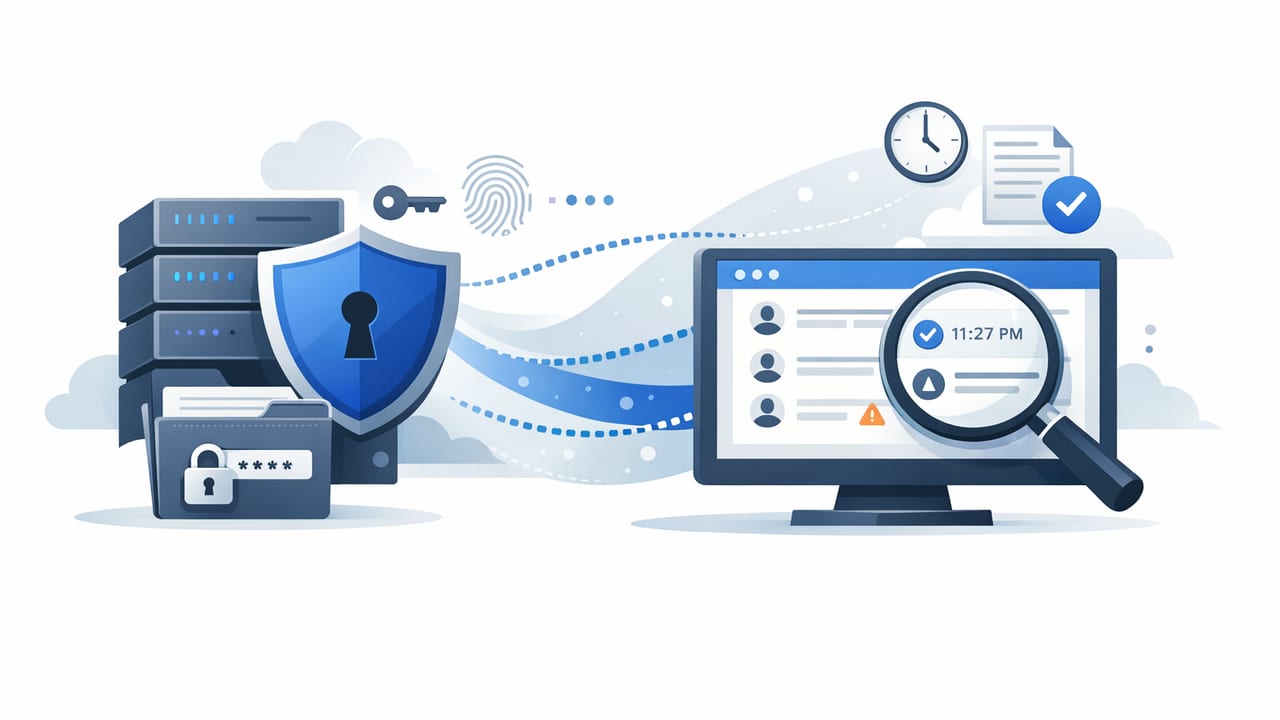
Secrets—passwords, API keys, database credentials, certificates, and signing tokens—are the quiet backbone of modern infrastructure. They’re also one of the fastest ways to lose control of security when they’re copied into tickets, shared in chat, embedded in code, or manually rotated with no record of who did what. That’s why more organizations now treat secrets governance as a first-class program, not a one-off tool choice.
If you’re evaluating enterprise secrets management software with audit trails, you’re likely balancing two pressures at once: you need tighter controls (least privilege, rotation, segregation of duties) and you need to prove those controls work (evidence for audits, investigations, and compliance reporting). This guide explains what “audit-ready” really means, what to look for in audit trails, and how to implement secrets management in a way that stands up to scrutiny without slowing teams down.
Why audit trails matter in secrets management
Audit trails are more than a log file. In a mature program, auditability provides:
- Accountability: ties every secrets action to a human or workload identity.
- Incident speed: shortens investigation time when a token is abused or leaked.
- Compliance evidence: supports SOC 2, ISO 27001, PCI DSS, HIPAA-aligned programs, and internal control frameworks.
- Change governance: shows approvals and enforced workflows for high-risk secrets.
- Operational reliability: makes it clear when rotation, rollout, or automation failed.
“If you can’t reconstruct who accessed a secret, when, from where, and under what authorization, you don’t have control—you have hope.”
What an audit trail should capture (minimum viable evidence)
Not all “audit logs” are equal. For enterprise use, audit trails should be tamper-resistant, complete, and queryable. At minimum, look for these fields and behaviors:
1) Identity and authentication context
- Actor identity: user ID, service account, workload identity, or federated subject.
- Auth method: SSO, OIDC, SAML, mTLS, Kubernetes auth, etc.
- Session context: device or client type, token ID, session ID.
2) Action and target details
- Action: read, list metadata, create, update, delete, rotate, revoke, export, policy change.
- Resource identifiers: secret path/name, environment, project, namespace, or vault.
- Versioning: which secret version was accessed (critical for forensics).
3) Authorization decision
- Allowed/denied: both should be logged.
- Policy trace: which policy/role granted access (or which control blocked it).
- Just-in-time elevation: approval references for temporary access.
4) Time, location, and integrity controls
- Timestamp: consistent time source, ideally with millisecond precision.
- Source: IP, region, cluster, node, workload identity, or VPC.
- Integrity: append-only storage, WORM options, or cryptographic signing.
Example: an audit event shape
Even if your platform doesn’t expose this exact schema, your log exports should make it possible to answer the “who/what/when/where/how/why” questions.
{
  "timestamp": "2026-04-18T14:03:22.418Z",
  "actor": {
    "type": "workload",
    "subject": "spiffe://prod/ns/payments/sa/checkout-api",
    "auth_method": "kubernetes",
    "session_id": "b7f2d0..."
  },
  "action": "secret.read",
  "resource": {
    "path": "prod/payments/db/primary",
    "version": "12"
  },
  "decision": {
    "result": "allow",
    "policy": "payments-db-read",
    "reason": "rbac:role=payments-runtime"
  },
  "source": {
    "ip": "10.21.8.14",
    "cluster": "prod-us-east-1",
    "namespace": "payments"
  }
}
Core capabilities to look for in enterprise secrets management software with audit trails
Audit trails are strongest when paired with controls that reduce the number of “exception” scenarios auditors worry about. Evaluate the platform as a system, not a single feature.
Access control and governance
- Fine-grained RBAC/ABAC: policies by environment, app, team, or secret class.
- Separation of duties: ability to prevent one person from creating and approving high-risk access.
- Just-in-time access: time-bound elevation with approval workflows.
- Break-glass: emergency access with strong logging, alerting, and post-incident review requirements.
Secret lifecycle automation
- Rotation: scheduled and event-driven rotation, with rollback safety.
- Leasing/TTL: short-lived credentials where possible (dynamic DB creds, ephemeral tokens).
- Revocation: fast disablement when exposure is suspected.
Audit log quality and exportability
- Real-time export: streaming to SIEM (Splunk, Sentinel, QRadar) or log pipelines.
- Immutable retention options: configurable retention and legal hold support.
- Structured logs: JSON with consistent fields (not free-text only).
- Search and reporting: built-in queries for common audit questions.
Platform integrations that reduce risk
- CI/CD integration: avoid plaintext variables; issue short-lived tokens to pipelines.
- Kubernetes integration: workload identity, secret injection, and namespace scoping.
- Cloud IAM integration: federation to AWS/GCP/Azure identity sources.
How to implement an audit-ready secrets program (practical steps)
- Inventory secrets and classify them: human vs machine, production vs non-production, high-impact systems, regulated data access.
- Define naming and ownership standards: each secret should have an owner team, a purpose, and a rotation expectation.
- Choose a default access model: deny-by-default with role-based grants, plus time-bound escalation for exceptions.
- Enable versioning and disable “silent overwrites”: ensure updates create new versions and preserve access history.
- Turn on audit logging everywhere: reads, writes, policy changes, auth failures, denied requests.
- Stream logs to your SIEM: centralize detection and long-term retention outside the secrets platform.
- Automate rotation for the top secrets first: production database credentials, signing keys, cloud access keys.
- Prove it with drills: run quarterly exercises: “Which workloads accessed X secret in the last 7 days?”
Common audit questions your logs must answer
When security teams and auditors review secrets, they tend to ask repeatable questions. Your enterprise secrets management software with audit trails should support answering these quickly:
- Access: Who accessed secret S between dates A and B, and from which systems?
- Change: Who changed secret S, what version changed, and was the change approved?
- Policy: Who granted access to secret S, and which policy enabled it?
- Anomalies: Did any identity access more secrets than normal, or access from a new location?
- Break-glass: Was emergency access used, and was it reviewed afterward?
Example SIEM-style query logic (pseudocode)
// Find reads of a specific secret outside expected namespace
SELECT timestamp, actor.subject, source.cluster, source.namespace
FROM audit_logs
WHERE action = 'secret.read'
  AND resource.path = 'prod/payments/db/primary'
  AND source.namespace != 'payments'
ORDER BY timestamp DESC;
Feature comparison table: what “good” looks like
| Capability | Basic tooling | Enterprise-ready expectation |
|---|---|---|
| Audit trails | Partial events, limited retention | All events, structured logs, export, long retention, integrity controls |
| Access control | Coarse roles | Fine-grained RBAC/ABAC, JIT access, separation of duties |
| Rotation | Manual reminders | Automated rotation with failure handling and audit evidence |
| Dynamic secrets | Static credentials stored long-term | Short-lived credentials (TTL) with automatic revocation |
| Integrations | Limited SDK support | Kubernetes/CI/CD/cloud IAM integration and workload identity |
Pitfalls that weaken audit trails (and how to avoid them)
- Logging only writes, not reads: read access is often the most important forensic signal. Log both.
- “List” endpoints without visibility: listing secret names/metadata can be sensitive—log it distinctly.
- Shared accounts: if teams use shared admin users, your audit trail becomes attribution-free. Enforce SSO and unique identities.
- No policy traceability: if you can’t see which policy allowed access, you can’t prove least privilege.
- Logs stored only inside the platform: export to independent storage/SIEM to reduce tampering risk and meet retention needs.
- Overly broad break-glass: emergency paths should be time-bound, alerted, and reviewed with clear evidence.
Evaluation checklist for your next platform review
Use this as a procurement and architecture checklist when comparing tools:
- Audit trail completeness: reads, writes, deletes, policy changes, auth events, denied events.
- Audit trail usability: structured fields, easy search, filters by actor/resource/time.
- Export and retention: real-time streaming, long retention, immutable storage option.
- Identity support: SSO, SCIM, workload identity, MFA enforcement, device posture (if relevant).
- Least privilege: granular policies, environment boundaries, approvals for sensitive actions.
- Automation: rotation, dynamic secrets, revocation, and safe rollout patterns.
- Operational controls: rate limiting, alerting hooks, HA/disaster recovery, backup/restore with auditability.
Putting it together: a simple target operating model
A practical and auditable model many enterprises adopt looks like this:
- Developers request secrets access through roles tied to apps/environments; no direct production admin by default.
- Workloads authenticate via identity federation (Kubernetes, cloud IAM, OIDC) and retrieve secrets at runtime.
- Security owns baseline policies, break-glass workflows, and SIEM monitoring.
- Audit trails stream to a central log system with retention aligned to policy and regulation.
Conclusion
Choosing enterprise secrets management software with audit trails is ultimately about proving control at scale: every access is attributable, every change is explainable, and every exception is visible and reviewable. The best outcomes come from pairing strong audit trails with least-privilege policy design, automation (rotation and TTL), and reliable log export into your broader security monitoring stack.
If you’re compiling a shortlist, include a hands-on test where you simulate common audit questions and confirm the platform can produce clear, exportable evidence. Some teams evaluating modern options add solutions like Vaulify to their comparisons, focusing specifically on auditability, automation, and day-to-day usability.