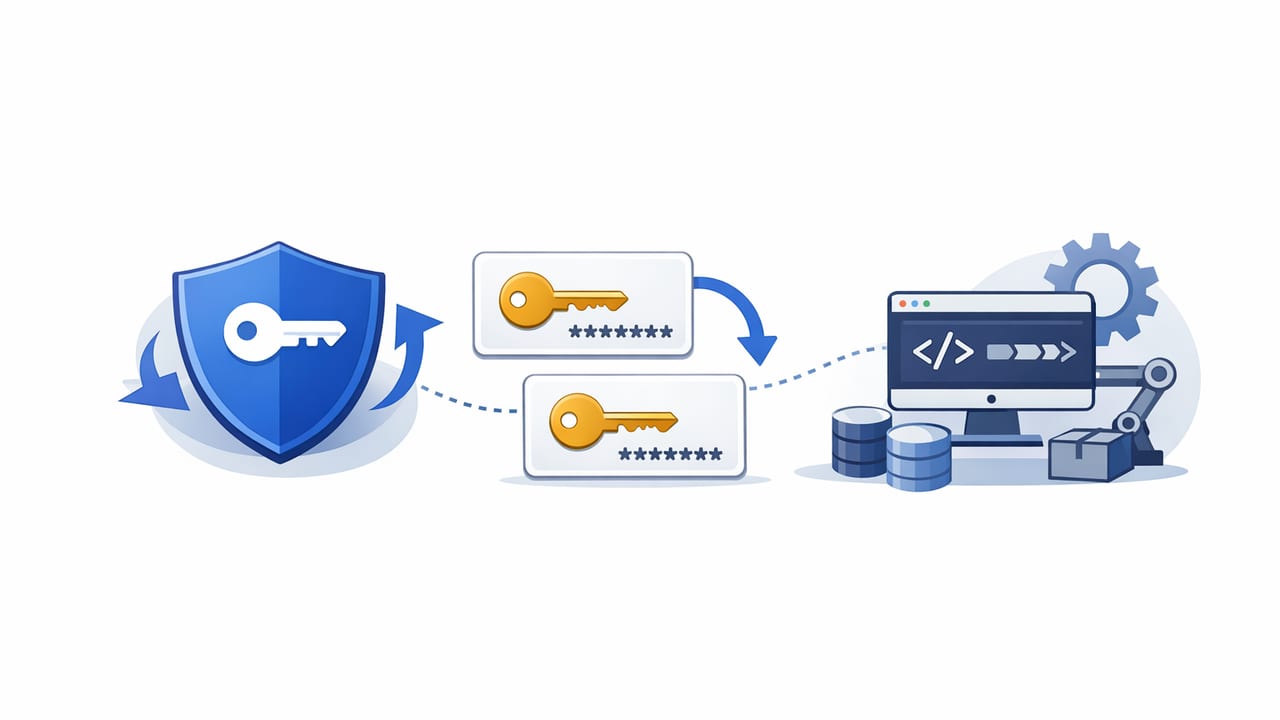
A well-designed api key rotation policy for ci-cd pipelines reduces blast radius when credentials leak, limits insider risk, and improves audit readiness. The challenge is doing it without breaking deployments, slowing developers, or turning “rotation” into a manual calendar reminder.
This guide provides an implementable policy blueprint: how to define scope, choose rotation cadence, automate rotation safely, and verify usage—specifically for CI/CD systems like GitHub Actions, GitLab CI, Jenkins, CircleCI, and cloud build services.
Why CI/CD API keys are uniquely risky
CI/CD pipelines often run with broad permissions because they need to build, test, publish artifacts, deploy infrastructure, and update environments. That makes pipeline-held API keys a high-value target. Common failure modes include:
- Long-lived keys stored as static secrets in CI variables with no expiry.
- Over-privileged tokens shared across multiple repos or environments.
- Key sprawl (the same key copied into multiple jobs, runners, and scripts).
- Untracked usage—teams can’t answer “where is this key used?” during an incident.
An effective api key rotation policy for ci-cd pipelines addresses these issues by standardizing ownership, cadence, automation, and verification.
What “rotation policy” should mean (not just “rotate every 90 days”)
A rotation policy is a set of rules and mechanisms that ensure keys are:
- Issued intentionally (documented owner, purpose, environment).
- Scoped minimally (least privilege, limited resources, limited time).
- Rotated predictably (schedule and triggers) and rotated safely (no downtime).
- Auditable (creation, changes, and usage are logged and reviewable).
- Revocable quickly (kill switches, emergency rotation).
Define scope: which credentials count as “pipeline API keys”?
Start by classifying secrets your CI/CD uses. Not everything needs the same cadence, but everything should have an owner and a plan.
- External service API keys: SaaS platforms, monitoring tools, payment providers.
- Cloud access tokens/keys: AWS access keys, GCP service account keys, Azure secrets.
- Package registry tokens: npm, PyPI, Docker registries, internal artifact repos.
- Deployment credentials: SSH deploy keys, Kubernetes service account tokens, webhook secrets.
Also define environments: production, staging, dev. A common policy mistake is allowing a single key to span environments “for convenience.” Avoid that—separate keys per environment and per pipeline purpose.
Core policy components (copy/paste into your security standard)
1) Ownership and inventory requirements
- Every key must have a documented owner (team), system of record (where it’s stored), and purpose (which pipeline/job uses it).
- Keys must be labeled/tagged where supported: app, env, repo, rotation-cadence, creation-date.
- Keys must be discoverable via an inventory report (at minimum: list + last rotated date + last used date if available).
2) Least privilege rules
- Prefer scoped tokens over “account-wide” keys.
- Restrict by resource (only required APIs/projects), action (read vs write), and environment.
- Disallow shared “global” keys across multiple repositories unless formally approved and monitored.
3) Rotation cadence and triggers
Cadence should be risk-based. Use shorter lifetimes for higher privilege and higher exposure. In addition to time-based rotation, define event-based triggers.
| Key Type | Typical Privilege | Recommended Rotation | Notes |
|---|---|---|---|
| Deployment keys (prod) | High | 30–60 days | Use dual-key rollout to avoid downtime |
| Package publish tokens | Medium–High | 60–90 days | Prefer scoped registry tokens per repo |
| SaaS read-only tokens | Low–Medium | 90–180 days | Rotate sooner if exposed to many runners |
| Ephemeral tokens (OIDC/STSv2) | High but short-lived | Minutes–hours | Policy focuses on trust config, not manual rotation |
Event-based rotation triggers (rotate immediately) should include:
- Suspected leak (logs, artifacts, paste sites, Git history).
- Repo visibility change (private → public).
- Pipeline runner compromise or untrusted runner exposure.
- Privilege increase (scope expanded) or ownership transfer.
- Staff departure from the owning team when keys were managed manually.
4) Storage and access rules for CI/CD
- Keys must be stored only in approved secret stores or CI secret managers—never in code, config files, or container images.
- CI jobs should receive secrets at runtime, scoped to the job, and not write them to disk unless unavoidable.
- Disable secret echoing; redact patterns in logs; prevent secrets from entering build artifacts.
Automation patterns that make rotation painless
The fastest way to improve an api key rotation policy for ci-cd pipelines is to reduce how many long-lived keys you have in the first place.
Pattern A: Replace static keys with OIDC + short-lived tokens
Many CI providers can mint an OIDC identity token for each job. You exchange that for short-lived cloud credentials (AWS STS, GCP Workload Identity Federation, Azure federated credentials). Benefits:
- No stored cloud access keys in CI.
- Credentials auto-expire (minutes to hours).
- Strong audit trail tied to a specific job run.
If you can move a credential from “static secret” to “ephemeral identity,” you largely eliminate traditional rotation pain and shift the policy focus to identity trust and permission boundaries.
Pattern B: Dual-key (overlapping) rotation for zero downtime
Some services require API keys that are long-lived. To rotate without breaking deployments:
- Create a new key (Key B) while Key A remains valid.
- Update CI/CD secret to use Key B.
- Deploy and verify all pipelines/consumers are using Key B.
- Revoke Key A after a soak period (e.g., 24–72 hours).
This requires the upstream service to allow multiple active keys per account/app. If it doesn’t, you must coordinate a maintenance window or implement a proxy layer.
Pattern C: “Brokered secrets” via a secrets manager
Instead of storing API keys directly in CI settings, pipelines authenticate to a central system (often via OIDC, mTLS, or a short-lived token) and fetch the current key at runtime. Rotation then becomes a back-end operation with minimal CI changes.
Reference workflow: implementing rotation in CI/CD
Below is a generic, tool-agnostic approach. The goal is to ensure every key follows the same lifecycle.
Step 1: Create an inventory
- List every CI secret variable and map it to a service key/token.
- Record: owner, environment, privilege, last rotated date, and where it is used (repo/workflow/job).
- Identify “shared keys” used by multiple repos—these are priority targets for redesign.
Step 2: Define “rotation-ready” technical requirements
- Upstream service supports multiple keys or staged rollouts.
- CI supports environment-scoped secrets (prod vs non-prod separation).
- Automation can update secrets (API access to CI secret storage or external secret store).
- Monitoring exists to detect failed auth and alert quickly after rotation.
Step 3: Automate rotation (example pseudocode)
The exact APIs differ by provider, but the pattern is consistent: create new key → update secret → verify → revoke old key.
# rotate_key.sh (illustrative)
set -euo pipefail

SERVICE_APP_ID="${SERVICE_APP_ID}"
CI_SECRET_NAME="PAYMENTS_API_KEY"

old_key_id=$(service-cli keys current --app "$SERVICE_APP_ID" --json | jq -r .active_key_id)
new_key=$(service-cli keys create --app "$SERVICE_APP_ID" --json)
new_key_value=$(echo "$new_key" | jq -r .key)
new_key_id=$(echo "$new_key" | jq -r .id)

ci-cli secrets set --name "$CI_SECRET_NAME" --value "$new_key_value" --env prod

# Verification gate: run a lightweight auth check or smoke test
./smoke_test_payments_auth.sh

# Revoke after verification (or after a soak period)
service-cli keys revoke --app "$SERVICE_APP_ID" --key-id "$old_key_id"

echo "Rotated: old=$old_key_id new=$new_key_id"
Step 4: Add a CI job to enforce the policy
A simple enforcement job can check metadata (last rotated date) and fail or warn when keys are nearing expiry. If your org stores metadata in a file or secret inventory system, you can validate it in CI.
# Example: policy check (illustrative)
python - <<'PY'
import json, datetime

MAX_DAYS = 90
with open('secrets_inventory.json') as f:
    inv = json.load(f)

today = datetime.date.today()
violations = []
for item in inv:
    rotated = datetime.date.fromisoformat(item['last_rotated'])
    age = (today - rotated).days
    if item['env'] == 'prod' and age > MAX_DAYS:
        violations.append((item['name'], age))

if violations:
    raise SystemExit("Rotation policy violations: " + ", ".join(f"{n}({a}d)" for n,a in violations))
print("Rotation policy: OK")
PY
Verification: how to know rotation didn’t break anything
Rotation fails most often because a “hidden consumer” still uses the old key. Build verification into the policy:
- Usage telemetry: prefer services that show last-used timestamps per key.
- Canary pipeline: run an auth-only smoke test using the new key before revoking the old one.
- Staged rollout: update non-prod first, then prod after successful runs.
- Soak period: keep old key valid for 24–72 hours if multiple pipelines deploy at different times.
Auditing and compliance: what evidence to keep
Even if you’re not pursuing formal certification, audit-ready records reduce incident time and confusion. For each rotation, capture:
- Who/what performed rotation (human vs automation identity).
- When the new key was created and when the old key was revoked.
- Which repos/environments were updated.
- Verification result (smoke test run ID, deployment IDs).
Store this as immutable logs or a ticketing record linked to the key ID. Your api key rotation policy for ci-cd pipelines should explicitly require retention duration (e.g., 1 year) based on your regulatory needs.
Common pitfalls (and how the policy prevents them)
- “We rotate, but the old key stays active.” Require revocation as a mandatory final step (or after a defined soak period).
- Rotation causes outages. Mandate dual-key rotation where possible and require smoke tests before revocation.
- Keys are rotated but still over-privileged. Make least privilege a prerequisite; don’t rotate bad keys—replace them with better-scoped ones.
- One key used everywhere. Require separation by environment and by workload; disallow cross-repo shared secrets without approval.
- Manual rotation gets skipped. Set an automation expectation: scheduled rotation jobs and alerting for drift.
Printable checklist: minimum viable rotation policy
- Inventory exists for all CI/CD-held keys (owner, purpose, env, last rotated).
- Rotation cadence defined by key type and privilege.
- Event-based triggers documented (leak, runner compromise, scope change).
- Zero-downtime rotation procedure (dual-key + verification + revoke) documented.
- Prefer ephemeral credentials (OIDC) for cloud deployments where supported.
- Audit logs retained and reviewable.
Closing thoughts
A strong api key rotation policy for ci-cd pipelines is less about forcing everyone to rotate every X days and more about designing pipelines so rotation is safe, automated, and observable. Start with your highest-privilege deployment credentials, adopt dual-key rollouts, and aggressively replace static cloud keys with short-lived identity-based access.
If you already use a centralized secrets platform, it can help standardize inventory, access controls, and automated rotation workflows; teams sometimes evaluate solutions like Vaulify for that role when they outgrow ad-hoc CI variables.